This tour is categorised as 3 out of 5
Balanced exploration with walking tours: Our most popular style, this tour offers a good mix of planned activities and free time. Expect moderate daily walking tours, so pack comfortable shoes.
As a general requirement across all of our trips, you may be required to walk up and down stairs, get on and off transportation, handle your own luggage, and participate in all scheduled sightseeing that may be conducted on uneven ground and terrain. Any physical ailments you may have must be disclosed at the time of booking to determine your suitability and where required, supporting documentation may be requested to ensure that we are comfortable that you will enjoy your trip.
For the true explorer, expedition small-ship cruising is the best way to get off the beaten track.This experience is not just about the ship’s creature comforts but very much the destination, its nature and wildlife. Daily shore excursions by Zodiac inflatable boats allow you to step onshore and explore. A world-class, expert expedition team will help you discover each exciting destination. Onboard you’ll enjoy informative and educational lectures. These trips will be a mix of fully guided or self-guided depending on your chosen package. There’s a land touring component with shared sightseeing and transfers.
✓ Travel with Hurtigruten
✓ The best local insider view of the Norwegian coast
✓ Norway’s wild and dramatic coastline is made for expedition-style adventure. Sailing here for almost 130 years, we’re the experts, showing travellers both its highlights and its hidden gems.
✓ Explore every place for a half or full day, and join a wide range of excursions.
✓ Visit the famous Norwegian fjords on the world’s most beautiful voyage
✓ Experience the Midnight Sun in summer, and the Northern Lights in winter
✓ Fresh ingredients are grown and harvested naturally along the coast, and delivered directly to our chefs.
✓ Breakfast, lunch and dinner including beverages (house beer and wine, sodas, and mineral water) in restaurant Aune and Fredheim
✓ English-speaking Expedition Team who organise and accompany activities on board and ashore
✓ Complimentary Wi-Fi on board
Travel with the experts for a carefully curated, value-packed discovery of the world's most iconic destinations. Our tours are bursting with must-see sights, rich experiences and quality inclusions, all at an unbeatable price. Bucket list dreams are ticked off on these all-encompassing journeys.
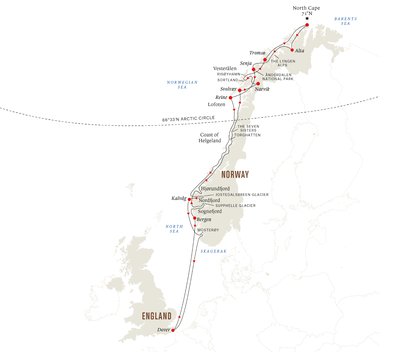
All aboard at Dover! MS Maud is here, ready and waiting to bring you north to Norway´s magical snow-covered landscapes on the hunt for one of nature’s greatest spectacles: The Northern Lights.
If you’ve time, take a walk alongside or atop the iconic white cliffs of Dover that have become a symbol for England. One of the best places to do so is at St. Margaret’s Bay which offers great views of the chalky coastline from its wide shingle beach.
Once on board the ship, you’ll pick up your complimentary expedition jacket, settle into your cabin, explore the ship and attend a mandatory safety drill. After the first of many delicious dinners and a welcome toast by the Captain, you’ll meet your expert Expedition Team.
They are your knowledgeable lecturers, warm hosts, and good-natured guides throughout your journey. Many grew up and live in the places you’ll be visiting and are passionate about sharing their home with you.
First and foremost though, they are there to keep you safe and well. They’ll be making it a priority to run through important health and safety aspects with you and your fellow guests.
When the ship sets sail, we’ll pass the white cliffs of Dover and head up to the North Sea. Stretch your sea legs and get to know MS Maud, your cosy home away from home. If the weather holds, take in the sea air from out on deck.
Or park yourself in the Explorer Lounge and Bar to watch the world go by from the panoramic windows, maybe together with a relaxing glass of wine. Your epic adventure to the Arctic is officially underway!
This day at sea gives you all the time you need to ease into your journey. You’ll definitely want to start enjoying onboard facilities like the hot tubs, sauna, and indoor gym. But you’ll likely also be striking up a camaraderie with the Expedition Team as well as other crew members and guests.
The Expedition Team will begin the first in their series of insightful lectures over at the Science Center. Each member of the Expedition Team are experts on different subjects, and you’ll find them to be walking, talking treasure troves of stories and information.
They’ll share their extensive knowledge about the places, history, nature, people and natural phenomena we are likely to encounter during this winter cruise along the Norwegian coast. Today’s topics might include the geology of the North Sea or the science behind the Northern Lights.
Even as no one can completely predict the weather, wind and waves on the North Sea are known to be a bit choppy at this time of year. Our Captain’s goal is to bring us into Bergen the next day, but where nature is involved, nothing can be completely set in stone.
This is just part and parcel of the expedition experience, adding extra suspense and excitement to your adventure. Rest assured that we’ll be doing our best to make your cruise as safe and as smooth as possible, even if it means being flexible and adapting our plans to factor in the elements.
Depending on the weather when crossing the North Sea, we aim to arrive in Bergen in the afternoon. As our first port of call in Norway, and one of the country’s most picturesque cities, Bergen won’t disappoint. Founded in 1070 AD, Bergen was Norway’s capital for many years, and you’ll see that the city has retained a great deal of its local character, heritage and charm.
Your included activity in Bergen is an excursion to Mount Fløyen. We’ll hop on Hurtigruten buses from where the ship docks and drive to the Fløibanen funicular. The ride to the top of the mountain takes just six minutes. At the summit, 320 metres high, bask in stunning views over the city surrounded by seven mountains and the sea. If there’s time, we might also have an opportunity to venture into the alpine forest here for a short hike.
Once back in the centre of Bergen, be sure to stroll through the historic UNESCO-listed Bryggen district with its colourful wooden wharfs. The area dates back to the 14th century and now houses boutique stores selling a range of Norwegian arts and crafts. Across from Bryggen is Bergen’s famous fish market which is full of sights, sounds and scents to savour.
In the morning we sail into Sognefjorden, nicknamed the ‘King of the Fjords’, as it is the longest and deepest fjord in Norway. Stretching 205 kilometres inland from the coast, we plan to cruise deep into the fjord to the tiny hamlet of Fjærland.
Only 300 people live here, and you get to go ashore to discover this idyllic village with many charming old buildings. Fjærland is a designated Norwegian Book Town, and picturesque second-hand book shops and stands can be found all over the small village.
This is also the place where Sognefjorden meets one of Norway’s best-known glaciers, Jostedalsbreen. It’s the largest glacier on the European continent and has several smaller glacier arms stretching out in many directions, including Bøyabreen and Supphellebreen.
This makes Fjærland a perfect place to learn more about how glaciers created the beautiful fjords of Norway, which makes a visit to the Norwegian Glacier Museum a perfect included activity of the day.
At the award-winning museum, designed by world famous architect Sverre Fehn, you’ll engage with hands-on exhibits that explain why glacier ice is blue and how the fjords were formed. You can even perform a few experiments with 1,000-year-old glacier ice and watch a panoramic film about Europe’s largest glacier.
Like famous Geirangerfjord next door, Hjørundfjord is part of the UNESCO designated Fjords Norway area which is notable for “exceptional natural beauty”. Surrounded by the Sunnmøre Alps with peaks soaring 1,700 metres straight up from the sea, it is one of the most scenic fjords in all of Norway and still undiscovered by most other cruise lines.
On a clear day, you’ll get the full 360° sensory experience: the bluest skies, the coniferous forests, perhaps in fall foliage and grazing pastures covering the mountainsides. The still, pristine waters then reflect the superb scenery in all its glory, merging the fjord and landscape perfectly.
We anchor close to either Urke or Sæbø, both settlements in the fjord and a local tender boat will take you ashore to experience Norwegian nature and culture.
Sign up for optional excursions to explore the area further. Join a guided walk taking in villages along the Hjørundfjord and learn about the history, nature and royal connections of this splendid beauty spot.
Alternatively, you can opt for more exhilarating, pulse-raising excursions such as hiking up the mountain for incredible views. Or find yourself kayaking along the fjord, the exquisite silence broken only by the sound of your own paddle.
Today, we’ll explore rarely seen areas of the rugged and raw coast of Trøndelag on our way north towards Lofoten.
This region of Norway lies at the heart of the Norwegian coast, both geographically and culturally. The beautiful city of Trondheim used to be the country’s capital and King Olav, later beatified as Saint Olav, is buried in the city’s Notre-Dame-inspired Nidaros Cathedral. King Olav fell during a battle at Stiklestad, also found along Trøndelag’s coast. His martyrdom there subsequently paved the way for the conversion of Norway from paganism to Christianity.
When Hurtigruten started sailing north of Trøndelag in 1893, much was still unknown about the coastline. Over the years, we’ve become experts in these waters. Today, we are the only ones with the maritime knowledge and skill to take you through the many skerries and islets, and past fjord after fjord.
Trøndelag is also the home of kos – a uniquely Norwegian state of mind that celebrates the simple pleasures of warmth, kindness and togetherness. As we explore Trøndelag’s coast, you’ll combine kos with another quintessentially Norwegian concept: an intense love of nature and the great outdoors known as friluftsliv.
As part of an authentic adventure, it’s the weather that will determine our exact route and activities today. If the weather is pleasant, we can stay out among the islands along the coast. If otherwise, we can head into one of the many deep fjords. What may often look like a small gap in the coastline actually hides a deep fjord system which few ever visit. Unless you’re sailing with us, like you are!
Once the elements have helped us decide on our destination for the day, we’ll drop anchor and use our small exploration boats to get to shore. If conditions are right, you’ll be able to pick optional excursion hikes or kayaking, or possibly even both.
There are just a few places on Earth where you can sail north of the Arctic Circle in wintertime. The Norwegian coast is one of them. The ship will officially cross over the Arctic Circle sometime in the morning.
To mark the occasion in the tradition of Norwegian sailors, we’ll be inviting you out on deck for a special ceremony. Exactly what happens is something you’ll just have to find out on your cruise!
The Lofoten Islands are one of the most spectacular locations in all of Norway and maybe even the world. As we approach the archipelago, the sight of the massive wall of mountains and dramatic peaks rising up out of the sea is something you’ll never forget. Serene fishing villages sit nestled in the sheltered coves, all the more magical if dusted with the season’s snow and if the aurora is seen swirling above.
We sail along Vestfjord and arrive in Svolvær in the afternoon. This is the largest town in Lofoten with about 4,800 residents, many of whom work as fishermen. There are shops and art galleries to browse along the seafront promenade and rows of rorbuer, fishing huts, to admire.
You might spot wooden racks called hjell dotted around the shores of the town too. Locally caught cod is dried on these racks and later turned into tørrfisk, or stockfish in English, and prized as a local delicacy. Fishing is clearly an important way of life in Lofoten and the lecture for the day may focus on how cod effectively helped to build Norway into a country.
From where you get off the ship, it’s a short walk to your inclusive visit to the multicoloured Magic Ice bar. The former fish-freezing warehouse now displays a range of selfie-suitable ice sculptures that depict Lofoten life and Viking culture. Enjoy a signature spirit to warm you up, served in an ice glass of course!
Your expert Expedition Team will also flex their local knowledge by handpicking safe and spectacular hiking trails or snowshoeing areas to offer as optional excursions.
We arrive into Narvik in the morning, and we’ll stay in port until tomorrow afternoon, giving you time to really explore. The town has a spectacular setting on a peninsula surrounded by three fjords: The Ofotfjord, Rombaken, and Beisfjord.
The multiple mountains also help to shelter its popular ski slopes from strong coastal winds. And while Narvik is one of the most northerly towns in the world, some 220 kilometres within the Arctic Circle, it enjoys a milder climate than expected thanks to the North Atlantic Current.
Modern Narvik developed as an all-year port for Swedish iron mines, which made the town a strategic target for Germany during World War II. You’ll visit the Narvik War Museum to see exhibits and artifacts from the war, learning about the heroism of British and Allied troops in liberating the town from the Nazis.
Aside from the museum, you can enjoy galleries, shops, and restaurants which specialise in locally-sourced seafood from the fjords and reindeer meat from the mountains.
Optional excursions including riding the cable car to the top of Mount Narvik for the breathtaking views or hikes, snowshoeing or kayaking on the fjords. You might also go ice-fishing in small lakes close to Narvik or meet local Sámi who are indigenous to the area.
There could also be an optional excursion to Polarparken, the largest and northernmost animal park in the world. The likes of wolves, bears, lynx, moose, and reindeer roam within huge enclosures. If you visit at feeding time, you might be able to glimpse these animals close up.
We arrive into Narvik in the morning, and we’ll stay in port until tomorrow afternoon, giving you time to really explore. The town has a spectacular setting on a peninsula surrounded by three fjords: The Ofotfjord, Rombaken, and Beisfjord.
The multiple mountains also help to shelter its popular ski slopes from strong coastal winds. And while Narvik is one of the most northerly towns in the world, some 220 kilometres within the Arctic Circle, it enjoys a milder climate than expected thanks to the North Atlantic Current.
Modern Narvik developed as an all-year port for Swedish iron mines, which made the town a strategic target for Germany during World War II. You’ll visit the Narvik War Museum to see exhibits and artifacts from the war, learning about the heroism of British and Allied troops in liberating the town from the Nazis.
Aside from the museum, you can enjoy galleries, shops, and restaurants which specialise in locally-sourced seafood from the fjords and reindeer meat from the mountains.
Optional excursions including riding the cable car to the top of Mount Narvik for the breathtaking views or hikes, snowshoeing or kayaking on the fjords. You might also go ice-fishing in small lakes close to Narvik or meet local Sámi who are indigenous to the area.
There could also be an optional excursion to Polarparken, the largest and northernmost animal park in the world. The likes of wolves, bears, lynx, moose, and reindeer roam within huge enclosures. If you visit at feeding time, you might be able to glimpse these animals close up.
We arrive in Vesterålen early in the morning. It spans an area from Andøya in the north to Sortland in the south. Few have ever heard of Vesterålen and even fewer have explored its wild and diverse beauty. Our plan is to let you spend the entire day doing exactly that.
Vesterålen is known as a hiker's paradise, offering both easy hikes for great view and more challenging hikes. We also plan to put our kayaks in the water while we are in port, giving you the possibility to join an optional kayak activity. Whales are often spotted in this area in the winter, so you might even get to see the from your kayak.
Depending on the weather for the day, we will dock in Sortland, Risøyhamn or Harstad. Sortland is the administrative centre of the area, and with a population of about 10,000 people, it’s the largest town in Vesterålen. It’s nicknamed ‘the blue city in the straight’, due to the many blue houses in the city centre.
Risøyhamn has approximately 200 inhabitants, making it a small village even by Norwegian standards. But the first settlements here date back to the Stone Age thanks to teeming fishing grounds and natural shelter from wind and waves. To get to Risøyhamn, we have to sail through Risøyrenna, an artificial channel finished in 1922 specifically for Hurtigruten to get access to Vesterålen and Risøyhamn.
Should the weather conditions be harsh today, we will port in Harstad, located a little further inland. The church just outside of Harstad is considered to be the world’s northernmost medieval church. Next to is Trondenes Historical Center and the “Adolfkanonen”, an enormous cannon from WWII and the last remaining one of four built by the Nazis. Harstad also has a lot of splendid scenery for you to explore on an optional hike.
It’s time to explore Tromsø, capital of the Arctic. But before we do, we’ll be on the watch for humpback whales out on deck or in the Explorer Lounge. Families of these gentle giants are known to frequent the winter waters here, feeding on the abundant herring. The Expedition Team will also be on the lookout and alert you to any sightings.
We’ll reach the city of Tromsø in the early morning and we’ll spend the entire day and evening exploring its fascinating history, culture and bold architecture. The Arctic Cathedral is one of the most striking landmarks in Tromsø, especially when lit up at night. It features an attractive, huge stained-glass window that is well worth seeing up close.
Historically, Tromsø was a frontier town for returning hunters and explorers and acted as a launch point for several Arctic expeditions. Today, the city is often called the ‘Paris of the North’ because of its international and cultural diversity.
You can busy yourself by browsing the shops or sampling the region’s fresh produce in a range of restaurants. Feel like meeting some of the friendly locals? Tromsø is home to the world’s northernmost brewery, Mack Bryggeri, which also runs Ølhallen, a lively pub where townspeople go for a chat and a few pints.
Your included activity in Tromsø is a visit to the Polar Museum which is housed in a converted 1830s warehouse on the seafront. You’ll enjoy exhibitions that cover the city’s heritage as a base for famous trappers Henry Rudi and Wanny Wolstad, the first female hunter in Svalbard. Tromsø also played a crucial role in the expeditions of legendary explorers Fridtjof Nansen and Roald Amundsen.
Other winter activities available in Tromsø include optional excursions with our Expedition Team on nature hikes, snowshoeing, and aurora-hunting bus rides. And like many places in Arctic Norway, when there is enough snow later in winter, the landscape becomes the ideal place to engage in some exhilarating dog sledding.
Start the day by arriving at the small town of Honningsvåg. You’ll now visit one of the northernmost points in Europe as part of an included excursion.
The scenic bus ride from Honningsvåg passes small bays and tiny villages, then crosses a mountain plateau before arriving at spectacular North Cape. At 71°10’21´N, it is just 2,100 kilometres away from the Geographic North Pole, with only the Svalbard Archipelago in between.
Stand at the cliff’s edge and gaze out across the sparkling sea. The North Cape is the closest you may ever get to the top of the world. There’s the obligatory selfie at the Globe Monument to snap before visiting the North Cape Hall for several exhibits and a short film which chronicle the history of the cape. Back in Honningsvåg, enjoy a stroll by the pretty harbour, browsing the charming shops, houses and church. Like many towns in northern Norway, fishing is the main source of income here. The local restaurants offer fresh fish and seafood, with king crabs available all year round. This is the ship’s turning point and from here, we start our return trip southbound.
Alta lies well above the Arctic Circle at 70 degrees north. This is one of the northernmost towns in the world with a population over 10,000 and the biggest city in the vast wilderness of Troms and Finnmark County, making it the perfect destination for winter activities.
We’ll arrive here early in the morning and we’ll stay until tomorrow afternoon. The town is directly beneath the Auroral Oval, a zone known for consistent Northern Lights activity. If the heavens aren’t overcast, and the conditions are right, you might well be in for quite the show...
You’ll learn more about the aurora at the modern Northern Lights Cathedral in Alta, situated at the end of a cute pedestrian street. The titanium-clad building and its spiral belfry dominate the skyline here, all the more impressive when illuminated at night.
There is an interactive exhibition in the cathedral that chronicles how Norwegian scientist Kristian Birkeland established Alta as an epicentre for ground-breaking Northern Lights research in the late 19th and early 20th centuries. You’ll also be treated to a classical concert in the cathedral as part of your visit.
The following day will prove to you that there is much more to do in Alta besides hunting for the Northern Lights. Alta is home to many dogsledding teams, some of which compete in the biggest races in the world. You can visit one of the teams during an optional excursion, go on snowmobile tours, mountain hiking or riding snow-suitable fat bikes in the hills around Alta.
Troms and Finnmark county also forms part of the traditional lands of the indigenous Sámi whose livelihoods revolve around semi-nomadic reindeer herding. Not far from Alta is Máze, a Sámi village located along Kautokeino River, that you can visit and experience Sámi culture and food as part of an optional excursion.
When more snow falls as winter progresses, Alta is also prime territory for visits to snow hotels, dog sledding and snowmobiling. For example, the ice hotel in Sorrisniva has a new design every year and is open to visitors for tours. You will also be able to join optional excursions to go snowshoeing and hiking in the incredible tundra wilderness.
Alta lies well above the Arctic Circle at 70 degrees north. This is one of the northernmost towns in the world with a population over 10,000 and the biggest city in the vast wilderness of Troms and Finnmark County, making it the perfect destination for winter activities.
We’ll arrive here early in the morning and we’ll stay until tomorrow afternoon. The town is directly beneath the Auroral Oval, a zone known for consistent Northern Lights activity. If the heavens aren’t overcast, and the conditions are right, you might well be in for quite the show...
You’ll learn more about the aurora at the modern Northern Lights Cathedral in Alta, situated at the end of a cute pedestrian street. The titanium-clad building and its spiral belfry dominate the skyline here, all the more impressive when illuminated at night.
There is an interactive exhibition in the cathedral that chronicles how Norwegian scientist Kristian Birkeland established Alta as an epicentre for ground-breaking Northern Lights research in the late 19th and early 20th centuries. You’ll also be treated to a classical concert in the cathedral as part of your visit.
The following day will prove to you that there is much more to do in Alta besides hunting for the Northern Lights. Alta is home to many dogsledding teams, some of which compete in the biggest races in the world. You can visit one of the teams during an optional excursion, go on snowmobile tours, mountain hiking or riding snow-suitable fat bikes in the hills around Alta.
Troms and Finnmark county also forms part of the traditional lands of the indigenous Sámi whose livelihoods revolve around semi-nomadic reindeer herding. Not far from Alta is Máze, a Sámi village located along Kautokeino River, that you can visit and experience Sámi culture and food as part of an optional excursion.
When more snow falls as winter progresses, Alta is also prime territory for visits to snow hotels, dog sledding and snowmobiling. For example, the ice hotel in Sorrisniva has a new design every year and is open to visitors for tours. You will also be able to join optional excursions to go snowshoeing and hiking in the incredible tundra wilderness.
Today, we dock at Senja, one of the most ruggedly beautiful and less-visited islands in Norway. You’ll be awestruck by the scenery on display here and understand why it made CNN travel’s list for ’10 of the world’s most beautiful islands’.
We will find a location to drop anchor, possibly on one of the ports on the outside if weather permits. Should the weather be rough, we might move to Finnsnes. Either way, everything is set for a great day for exploring.
Senja is Norway’s second largest island but counts fewer than 8,000 inhabitants, most of whom are employed in fishing and aquaculture. The captain will decide on a location to drop anchor or a port where we can dock. Should the weather be rough on the coast side, we will seek more shelter in the bays or inlets.
Sometimes referred to as ‘Norway in miniature’, the island boasts diverse landscapes that seem to change in the blink of an eye. Senja’s northern coastline is characterised by lofty mountains plummeting straight into the sea, interspersed with isolated coves and sandy beaches that fringe crystal clear turquoise waters.
Southern Senja is distinguished by rocky coastline and pine forests and is home to Ånderdalen National Park. The eastern side of Senja has gentler, more forgiving landscapes with rolling hills and birch forests.
In the morning, we dock into the picture-perfect fishing village of Reine back in the Lofoten Islands. This is where red-painted, snow-covered rorbuer cling to a string of islands beneath sharp, dark grey granite mountain ranges. The 450-metre tall Reinebringen is one of the most distinctive peaks, particularly dramatic when layered with snow.
The combination of setting and colour makes Reine one of the most photographed landscapes in all of Norway. You’ll be hoping the Northern Lights are active above the village when we are there, completing the composition of your own photo of this piece of paradise.
After marveling at the scenery and discovering pretty Reine, you’ll go on your included activity for today. A 30-minute bus ride will take you to Å, one of the best-preserved traditional fishing villages in Norway.
At the heart of the tiny village is the Norwegian Fishing Village Museum which covers the importance and development of fishing in Lofoten over the last 250 years. Exploring at your leisure, you’ll soon discover that the village is the museum and the museum is the village.
Later, we return to Reine where there may be optional excursions to go on hikes with the Expedition Team or even try some winter kayaking. The views here will certainly tempt you to sign up to either. You’ll then rejoin the ship and marvel more at the surrounding scenery which is spell-bindingly beautiful, whether washed in the lights of the aurora or not.
Today you can spend time in the ship’s lounge, soaking in a hot tub, or out on deck. Whatever you do, don’t take your eyes off the scenery as we sail through Helgeland county, characterised by pointed mountains and thousands of islands.
Pick out the peaks of the Seven Sisters mountain range, thought to be the petrified bodies of seven troll sisters caught out at sunrise. You’ll likely be amazed at Torghatten mountain too, with its distinct hole right through the middle. Local legend states that the mountain was in fact the troll-king’s hat which turned to stone when it was pierced through by an arrow.
The Expedition Team will continue their onboard lectures which may cover local folklore and fairytales or a history of navigation along the coast from lighthouses to satellites. Or perhaps pick up tips from the professional onboard photographer on how best to capture the aurora when they appear.
We start the day with some scenic cruising into Nordfjord, passing Hornelen, Europe’s highest sea cliff, early in the morning. The fjord run offs from Jostedalsbreen, Europe's largest mainland glacier, and flows west into the ocean just south of the Stadlandet peninsula.
It would make sense if lectures for today focus on the geology of Norway, covering the formation of its fjords, mountains and glaciers. You might also learn more about the Viking culture that used to inhabit the region and their thirst for exploration that still beats in the hearts of Norwegians today.
You’ll spot numerous old fishing communities located along the fjord that actually date back to pre-Viking times. One such place is Loen, where we arrive around noon. In the shadow of the mighty Jostedalsbreen glacier, at the very heart of Nordfjord, Loen is the perfect place to explore the gorgeous surrounds.
We use our small boats to land at a floating jetty which is conveniently also a starting point for the Loen Skylift. The cable car climbs 1,011 metre to the top of Mount Hoven in only five minutes. At the summit, you’ll be treated to an unforgettable vista over the fjord. Mount Skåla and Lake Lo can be seen to the east, and Jostedalsbreen Glacier and Olden to the south.
With these panoramas all around you, you can participate in several optional winter activities on the mountain, such as snowshoeing or sledding. If time and weather allow, there might also be an opportunity to do some thrilling winter kayaking on the fjord.
We welcome you to the little fishing village of Kalvåg after breakfast, situated far out on the coastline with the open North Sea to the west. Its name literally means ‘Frozen Bay’ in the Old Norse. This probably gives you an indication that it isn’t always possible for our ship to make a landing here and that it does depends on the local weather and sea conditions at the time.
If and when you do come ashore here, you’ll discover one of the best kept secrets of the Norwegian coast. No other expedition ships visit Kalvåg so you’ll experience an authentic slice-of-life community who will likely be thrilled to have visitors.
As part of our traditional Norwegian coastal voyage, our Captains have sailed these waters for decades, always wishing there was time to stop and show you around this oh-so-charming village. We’ve listened to their expert recommendation and that’s now exactly what you’ll get to do on this expedition cruise.
Admire an open-air art exhibition and walk around Kalvåg’s collection of old waterfront buildings, from restored wooden wharfs to herring salting warehouses. Cosy-looking houses cluster together around the bay, the reflections of their lights shimmering like candles in the waters below. The wonderful wintery atmosphere is even more captivating if you come when the village is coated with a snug blanket of snow.
Your final day of exploration begins as we arrive at Mosterøy and Klosterøy in the morning, two of the myriads of islands that lie around the city of Stavanger. The islands are relatively exposed to the sea, so our going ashore here will be decided based on how kind the waves and wind are on the day.
Mosterøy is a lovely island made up of a mixture of pastures for cattle, horticulture, and cute neighbourhoods all around. To the west of the island is Fjøløy fort, a small coastal battery built by the German army in 1941 during World War II.
Klosterøy occupies less than a square mile but is home to the historic Utstein Abbey and the 800-year-old Utstein Church. The abbey is Norway’s best-preserved medieval monastery sitting in beautiful surroundings. Parts of the monastery are hired out as a venue for concerts, seminars, and conventions. On arrival, you might be greeted by guides in medieval costume.
The islands are connected by bridges and tunnels and all roads here lead to the city of Stavanger on the mainland.
This is the oil and energy capital of Norway, an international, cosmopolitan city which is as hip as it is historic.
You can learn more about Norway’s off-shore wealth on an optional excursion visit to the Norwegian Petroleum Museum. It is possibly the only one of its kind in all of Europe and built as a replica of an oil platform.
Few places in Norway have embraced the foodie scene as well as Stavanger. The city’s Michelin-starred restaurants have helped earn it the nickname of ‘The Food Pantry of Norway’. You can stroll down Øvre Holmgate and take your pick of café, pub, restaurant or boutique store.
While modernity thrives in avant garde gastronomy and Scandi street art, the city’s proud history is also never far from sight. Take a walk around the Gamle Stavanger neighbourhood which features 170 of Europe’s best-preserved wooden houses from the 18th century. You can also see Norway’s oldest domkirke, cathedral, constructed in the Anglo-Norman style around 1125 by an English Bishop, and virtually unchanged since the 1300s.
Your expedition is fast coming to an end. By this stage of your journey, you’ll have made friends with your fellow explorers, finding that you have much in common in terms of your interests and passion for nature.
You can spend time chatting with them over a snack at the bistro-like Fredheim, perhaps recalling the best moments of your expedition together. Enjoy drinks at the Explorer Bar while swapping friendly banter and stories of past adventures. You might even catch a couple of the crew and Expedition Team here too.
If you’d rather spend this last day at sea in quiet contemplation, you’ll likely have multiple memory cards full of Northern Lights photos and more to sift through and reminisce about. Take stock of everything you’ve seen and experienced with a blood-pumping session in the gym and then relax in the soothing steam of the sauna one last time.
We pass the white cliffs of Dover during the early morning hours and dock at the city’s harbour. After a final breakfast, it’ll be time to say a fond farewell to the ship, the Captain, crew, Expedition Team, and your new-found friends.
As you head ashore, you’ll take with you special memories of Norway in winter: wonderful fjords, fascinating towns and cities, friendly people, and the magical Northern Lights.
Dover acts as the gateway to English countryside, the verdant counties of Kent and Surrey, and beyond to the melting pot of London. But before you rush off, you might to like to visit Dover Castle, tipped to be the largest in England.
There is a rare Roman lighthouse here, one of only three in the world and reputedly the UK’s oldest building. You can also go on a tour of the underground hospital and secret WWII tunnels that run beneath the castle complex.
Whatever’s next for you, we wish you a safe onward journey and look forward to seeing you on your next adventure!
Departures
Cabin Bedding and Upgrades
Bedding on board the cruise is restricted to the following configurations. If you wish to upgrade your cabin, the following amounts are payable in addition to the package price prior to travel:
Polar Outside (L2): INCLUDED
Our Polar Outside cabins are mostly situated on the middle or lower decks and have a bathroom with a shower. These cabins also have a queen bed or separate beds. Each Polar Outside cabin has its own unique specifications.
Polar Outside (N2)
These standard outside cabins for two people on the middle decks have separate beds and private bathrooms. Upgrades from AU$1,000 per person, twin share or AU$1,450 per person, single (subject to availability).
Arctic Superior (P2)
Relaxation and comfort are hallmarks of the Arctic Superior cabins. Situated on both the upper and middle decks, the cabins all have a bathroom with a shower. Most have a queen bed, while some have separate beds. Each Arctic Superior cabin has its own unique specifications.Upgrades from AU$1,818 per person, twin share or AU$2,636 per person, single (subject to availability).
Expedition Suite (MG)
Our Expedition Suites are the most luxurious cabins on the ship. Situated on the upper decks of the ship, these cabins feature seating areas with a TV, a bathroom with a shower, and a queen bed. Each Expedition Suite has its own unique specifications. Upgrades from AU$16,002 per person, twin share or AU$37,404 per person, single (subject to availability).
Cabin Upgrades and prices are subject to availability upon booking. Please note your upgrade option as a special request when booking and our team will be in touch with a confirmed quote. If we are unable to confirm your request, we will quote alternative options.
Please request your cabin upgrade in the 'special requests' field. Availability and price will then be confirmed and added to your invoice upon acceptance.
MS Maud previously MS Midnatsol, is named after one of the most famous polar vessels of all time, Roald Amundsens “Maud” from 1917. The original “Maud” got her name from the first Queen of modern-day Norway. She also had her namesake in Hurtigruten’s 1925 flagship DS Dronning Maud (“DS Queen Maud”).
to know more about your ship, click HERE.
Onboard Features
Expedition Cruise
Onboard Activities
Landing Activities
Notes
Deposit & Payments
Booking Process
Booking On Request
COVID-19
Due to COVID there maybe disruptions to standard operating schedules of particular components of this itinerary. Should a component be effected a substitute will be confirmed prior to departure.
Fitness Requirements
While the tour itinerary should give you some guidance and overview to the expected requirements, to determine if this tour is right for you we categorise each of our tours in terms of their intensity.
These guidelines are to ensure that each tour group is conducted as expected and to ensure the overall satisfaction of all Inspiring Vacations customers. As a general rule, porterage is not included, therefore at all times you are expected to handle your own luggage where help may not be available.
Accommodation
The accommodation listed is subject to change. Any changes will be of an equal or higher standard. Bedding configurations (double or twin) are requests only and subject to availability. All efforts will be made to meet your preferences, however any changes are beyond our control.
Single Supplement
Please follow the 'book now' prompts and select 1 passenger to view the single supplement cost.
Triple Share
Not Available
Travel Insurance
Travel insurance is required to protect yourself against the unexpected.
Tour Documentation
Final documentation including, e-tickets and cruise details, will be provided approximately 30 days prior to travel.
Children
Children must share a room with parents at all times and are charged the same price as adults.
For all international voyages, it is the traveller's responsibility to ensure that they have a valid passport and they meet the visa requirement. The passport must be valid for a minimum of six months from the intended date of return.

 Australia
 New Zealand
 Canada