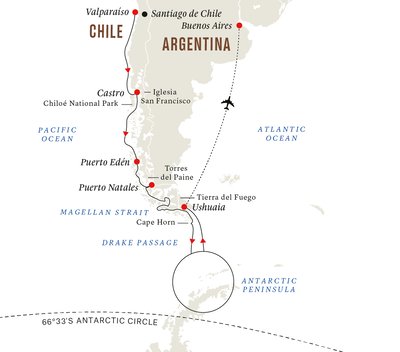
18 Day Antarctica & Patagonia Expedition (southbound) Onboard Ms Roald Amundsen
This tour is categorised as 3 out of 5
Balanced exploration with walking tours: Our most popular style, this tour offers a good mix of planned activities and free time. Expect moderate daily walking tours, so pack comfortable shoes.
As a general requirement across all of our trips, you may be required to walk up and down stairs, get on and off transportation, handle your own luggage, and participate in all scheduled sightseeing that may be conducted on uneven ground and terrain. Any physical ailments you may have must be disclosed at the time of booking to determine your suitability and where required, supporting documentation may be requested to ensure that we are comfortable that you will enjoy your trip.
For the true explorer, expedition small-ship cruising is the best way to get off the beaten track.This experience is not just about the ship’s creature comforts but very much the destination, its nature and wildlife. Daily shore excursions by Zodiac inflatable boats allow you to step onshore and explore. A world-class, expert expedition team will help you discover each exciting destination. Onboard you’ll enjoy informative and educational lectures. These trips will be a mix of fully guided or self-guided depending on your chosen package. There’s a land touring component with shared sightseeing and transfers.
✓ Travel with Hurtigruten
✓ Explore this wild and wonderful frozen continent
✓ See penguins, whales, and seals in their natural habitat
✓ Experience endless ranges of snow-coated mountains
✓ Discover the majesty of the iceberg sculpted by sun, wind, and waves
✓ Experience a beacon for abundant wildlife; whales, seals, seabirds, and penguins
✓ Go on landings ashore, on small boat cruises, kayaking, snowshoeing, camping, and more
✓ Hurtigruten’s ships combine hybrid technology with lowest CO2-footprint possible
✓ Enjoined with English-speaking Expedition Team activities onboard and ashore
✓ Complimentary Wi-Fi onboard
Two icons in one trip: mainland Italy and Sicily. Walk the frozen streets of Pompeii, sip wine on Vesuvius slopes, and hop a ferry to Capri before crossing overnight to Sicily Greek temples, medieval hill towns and craters of Mount Etna. Small-group touring means it never feels rushed, just endlessly rewarding.
Located on a picturesque bay? Check. Rows of colourful houses lining the hills? Check. A network of trams and funiculars that take you to scenic views? Check that too. A thriving arts scene and exciting foodie culture? Double check. With these shared similarities, it’s no wonder that vibrant Valparaíso is often compared, as a compliment, to San Francisco in the opposite hemisphere.
Depending on when you arrive here, you might be lucky enough to have some time to explore before embarking MS Roald Amundsen. If you plan ahead, you can even extend your voyage by adding our optional Pre-Programme adventure to the beautiful Atacama Desert.
However, if you are short on time, you can start by taking a stroll around Sotomayor Plaza to admire the architecture and spot ships in the nearby port. You could then head up into the Concepción Hills neighbourhood for panoramic viewpoints and trendy cafés, and make your way through the maze-like network of narrow streets. Baburizza Palace near Paseo Yugoslavo is home to the Municipal Museum of Fine Arts as well as a string of eateries that serve up sumptuous Chilean seafood such as conger eel stew, razor clams à la parmesan and scallops al pil pil chilli dressing.
Don’t fill up on too much local food though as, once you’re on board the ship, there’ll be a welcome dinner to feast on too! This usually takes place after checking-in, introductions to the Expedition Team, and the all-important health and safety meeting.
Two days at sea gives you all the time you need to ease into your journey and acclimatise for your adventure ahead. You’ll definitely want to explore the ship and start enjoying onboard facilities like the infinity pool, hot tubs, sauna, indoor gym, outdoor running track and spa. But you’ll likely also be having fun getting to know your Expedition Team as well as other crew members and guests. Share some drinks with them at the bar and strike up a camaraderie with your new ship mates.
Your entertainment during any day at sea are the informative lectures from the Expedition Team. Each topic is designed to help you fully appreciate the areas you are sailing through. You might learn about how tectonic activity formed the surrounding mountain ranges, followed by examining real rock samples in the ship’s Science Centre. Or perhaps, there will be an in-depth look at local history and culture that will inform your upcoming landings. Pick up fascinating facts about local sea birds like skuas or kelp gulls before grabbing a pair of binoculars and scanning for rare wandering albatross and various types of petrels.
However you choose to spend these sea days, the mixture of onboard activities and lectures are an opportunity to enhance your sense of exploration and to whet your adventurer’s appetite for what’s to come!
Two days at sea gives you all the time you need to ease into your journey and acclimatise for your adventure ahead. You’ll definitely want to explore the ship and start enjoying onboard facilities like the infinity pool, hot tubs, sauna, indoor gym, outdoor running track and spa. But you’ll likely also be having fun getting to know your Expedition Team as well as other crew members and guests. Share some drinks with them at the bar and strike up a camaraderie with your new ship mates.
Your entertainment during any day at sea are the informative lectures from the Expedition Team. Each topic is designed to help you fully appreciate the areas you are sailing through. You might learn about how tectonic activity formed the surrounding mountain ranges, followed by examining real rock samples in the ship’s Science Centre. Or perhaps, there will be an in-depth look at local history and culture that will inform your upcoming landings. Pick up fascinating facts about local sea birds like skuas or kelp gulls before grabbing a pair of binoculars and scanning for rare wandering albatross and various types of petrels.
However you choose to spend these sea days, the mixture of onboard activities and lectures are an opportunity to enhance your sense of exploration and to whet your adventurer’s appetite for what’s to come!
Tucked away off a fjord in the middle of Chiloé Island, Castro has evolved from Chile’s third oldest city into a cosmopolitan capital that still manages to be classic Chilote in character. The typical postcard picture that you’ll want to see for yourself are the brightly painted palafitos. These are traditional wooden stilt houses that you can find lining the edges of the fjord at Gamboa wharf. The nearby UNESCO-listed Church of San Francisco is also a masterpiece of carpentry made entirely of wood in a Neo-Gothic style.
Other attractions you might like to check out are the Plaza de Armas centre of the city, the impressive Museum of Modern Art of Chiloé, and the Regional Museum of Castro. You can also spend the day sampling the wide range of high-quality restaurants and gastro-pubs that have popped up here for the fresh seafood and views of the fjord.
We continue our voyage, setting course for Puerto Edén and passing by the many islands of Aysén, Chile’s most sparsely populated region. Part of being on an expedition is knowing how to enjoy the moment; taking time out to reconnect with nature and the world around you. So park yourself in the panoramic Explorer Lounge or soak in a hot tub out on deck, sit back and simply take in the serene scenery as untouched isles and green mountains roll quietly by. You’ll also be able to join the Expedition Team in the Science Centre so that they can continue to enthral you with details about the local geography, climate and birdlife.
This tiny hamlet lies along a bay on a remote peninsula that juts out into a fjord in the province of Última Esperanza. As we sail into the area, you’ll immediately appreciate that the port’s main draw is its access to the exceptional landscapes of Bernardo O’Higgins National Park, which were surely the inspiration for naming the hamlet ‘Eden’ to begin with. The park is the largest protected area in Chile, made up of a stunning network of silent fjords and beautiful mountains covered in native forests. Keep on the lookout for South Andean deer on the nearby slopes, marine otters in the water, and cormorants up above.
The climate of the region, that of frequent rainfall, high humidity and heavy storms, makes Puerto Edén only accessible by sea and one of Chile’s most hard-to-reach inhabited places. There are no roads to, from or even within the isolated village, just boardwalks and footpaths that connect the homes of its less-than 200 inhabitants. A dozen of these residents are the last known community of the indigenous Kawéskar people who make a living fishing and selling wicker baskets to any travellers that pass through.
Blessed with gorgeous views of the southern Andes, the port on Señoret Channel in Última Esperanza fjord has come a long way from its sheep industry origins. The city now acts as a launch pad for Torres del Paine National Park, attracting hikers from all over the world.
Aside from a full-day optional excursion to the national park, you can also spend some time leisurely exploring Puerto Natales on foot. This sleepy city is a mix of Bohemian bars, shops selling outdoor gear, corrugated tin houses, and eateries serving up global cuisine. Visit the artisan village at Etherh Aike for a range of souvenirs or drop in for drinks at the Last Hope Bar which also claims to be the southernmost distillery in the world.
Following the waterfront will grant you views across the fjord and there are photo-fantastic opportunities at the old pier, Monument to the Wind, and Monument of the Hand. Bird watchers should also be on alert for Andean condors and for famously pink Chilean flamingos, to name just a few. You might also come across a monument to 16th century Spanish explorer Juan Ladrillero. He named the fjord here ‘Last Hope’ because he felt the inlet was his last chance to reach the Strait of Magellan. He was proved right and went on to become the first person to successfully sail the strait.
Blessed with gorgeous views of the southern Andes, the port on Señoret Channel in Última Esperanza fjord has come a long way from its sheep industry origins. The city now acts as a launch pad for Torres del Paine National Park, attracting hikers from all over the world.
Aside from a full-day optional excursion to the national park, you can also spend some time leisurely exploring Puerto Natales on foot. This sleepy city is a mix of Bohemian bars, shops selling outdoor gear, corrugated tin houses, and eateries serving up global cuisine. Visit the artisan village at Etherh Aike for a range of souvenirs or drop in for drinks at the Last Hope Bar which also claims to be the southernmost distillery in the world.
Following the waterfront will grant you views across the fjord and there are photo-fantastic opportunities at the old pier, Monument to the Wind, and Monument of the Hand. Bird watchers should also be on alert for Andean condors and for famously pink Chilean flamingos, to name just a few. You might also come across a monument to 16th century Spanish explorer Juan Ladrillero. He named the fjord here ‘Last Hope’ because he felt the inlet was his last chance to reach the Strait of Magellan. He was proved right and went on to become the first person to successfully sail the strait.
Our journey down the Chilean coast continues south through the many broken isles and fabled fjords of Chile’s rugged Magallenes Province. We will be in the western part of the Strait of Magellan, so named after the famous 16th century Portuguese explorer who first traversed it.
The plan for today is that there isn’t one! After all, where’s the sense of fun and adventure if everything is scripted beforehand? The day’s activities and any landings will therefore be decided at the discretion of the Expedition Team. They will draw on their in-depth knowledge of the area to pick out the most interesting sites for you to explore, and based on the local weather conditions that day.
Whether cruising aboard small explorer boats or just out on deck aboard the ship, remember to scan the shores for picturesque waterfalls, birdlife, and maybe colonies of Magellanic penguins and, if lucky, elephant seals. In the waters themselves, you might get a rare glimpse of various species of whales.
We loop round glacier-carved Alberto de Agostini National Park and enter the Beagle Channel in the morning. Gaze at the sumptuous landscapes as we pass between the park and Isla Gordon of the Tierra del Fuego archipelago. If it’s a clear day, you may be able to see Monte Darwin towering to the north, part of the southernmost range of the Andean mountains. Exiting the channel midway, it is time to begin our crossing to Antarctica.
Before we do so though, there is one historical place that we might try to visit in honour of past sailors. At the tip of South America lies legendary Cape Horn, a major milestone in the old clipper routes that connected Europe with the Far East and Oceania. This is where the open waters of the Atlantic and Pacific collide, creating powerful waves that are made even stronger by swirling westerly winds. For yachters, rounding Cape Horn is a maritime feat akin to summiting Mount Everest. Given the notoriety of these turbulent waters, we can’t guarantee you a landing. But if fortune favours us on the day with weather stable enough to set foot on the island, you’ll be among a select few in the world able to boast about it.
From Cape Horn, it’s a clear shot to Antarctica across the Drake Passage. With no nearby landmass to break the currents, the waters here are fully exposed. Depending on the current, you might realise why some sea captains have come to nickname the passage the ‘Drake Shake’. Other times, conditions are at the other end of the spectrum and completely calm. In such cases, be grateful you were blessed with the ‘Drake Lake’ instead!
The Expedition Team will be hard at work on board to prepare you for the main event of your voyage: Antarctica! Lectures will focus on how to explore this sensitive environment in accordance with strict IAATO regulations. You’ll get clued up on the importance of maintaining a respectful distance from curious penguins and what practical measures we will be taking to prevent bio-contamination of the ecosystem with foreign particles.
If weather allows, spend some time out on deck taking in the fresh sea air. You might be accompanied by various seabirds who seem to enjoy following the ship from above. As the first icebergs appear on the horizon, a ripple of excitement never fails to spread throughout the ship, even to those crew who have been many times before. In the following days, you’ll understand why.
We loop round glacier-carved Alberto de Agostini National Park and enter the Beagle Channel in the morning. Gaze at the sumptuous landscapes as we pass between the park and Isla Gordon of the Tierra del Fuego archipelago. If it’s a clear day, you may be able to see Monte Darwin towering to the north, part of the southernmost range of the Andean mountains. Exiting the channel midway, it is time to begin our crossing to Antarctica.
Before we do so though, there is one historical place that we might try to visit in honour of past sailors. At the tip of South America lies legendary Cape Horn, a major milestone in the old clipper routes that connected Europe with the Far East and Oceania. This is where the open waters of the Atlantic and Pacific collide, creating powerful waves that are made even stronger by swirling westerly winds. For yachters, rounding Cape Horn is a maritime feat akin to summiting Mount Everest. Given the notoriety of these turbulent waters, we can’t guarantee you a landing. But if fortune favours us on the day with weather stable enough to set foot on the island, you’ll be among a select few in the world able to boast about it.
From Cape Horn, it’s a clear shot to Antarctica across the Drake Passage. With no nearby landmass to break the currents, the waters here are fully exposed. Depending on the current, you might realise why some sea captains have come to nickname the passage the ‘Drake Shake’. Other times, conditions are at the other end of the spectrum and completely calm. In such cases, be grateful you were blessed with the ‘Drake Lake’ instead!
The Expedition Team will be hard at work on board to prepare you for the main event of your voyage: Antarctica! Lectures will focus on how to explore this sensitive environment in accordance with strict IAATO regulations. You’ll get clued up on the importance of maintaining a respectful distance from curious penguins and what practical measures we will be taking to prevent bio-contamination of the ecosystem with foreign particles.
If weather allows, spend some time out on deck taking in the fresh sea air. You might be accompanied by various seabirds who seem to enjoy following the ship from above. As the first icebergs appear on the horizon, a ripple of excitement never fails to spread throughout the ship, even to those crew who have been many times before. In the following days, you’ll understand why.
We’ve arrived. You are finally here. And isn’t it a sight to behold. This other-worldly landscape of snow and ice can’t be found anywhere else on earth. The wind and waves work with the late spring sun to carve fresh icebergs into giant white and blue gems, some as tall as buildings. Immense ice shelves and crumpled glaciers seem to creak while crashing chunks of ice into the waters below. Vast ranges of mighty mountains sleep silently beneath blankets of soft snow. Welcome to the epic Seventh Continent. Welcome to Antarctica.
You’ll be spending the next four days intensively exploring several of more than 20 possible landing sites on and around the Antarctic Peninsula and South Shetland Islands. Wherever we go and whatever we do, each day in this vast, breathtaking region will offer you something different and thrilling. We might spend our time sailing into a flooded volcanic caldera or landing at dramatic bays that still harbour remnants of the whaling era. Or you’ll go ashore and stand in the presence of thousands of penguins, while keeping at least a few metres away from any inquisitive ones who come to inspect you. This being the Antarctic late spring, gentoo and chinstrap penguins will be at the start of their courting season while the more advanced Adélie penguins may have already laid their eggs and be in nesting mode. There are many other birds in Antarctica to see too, such as skuas, jaegers, petrels and terns. Unlike penguins, these ones can actually fly, so remember to point your binoculars up to the sky now and again.
The Expedition Team will be with you each step of the way, guiding you on landings and leading ice-cruises aboard small explorer boats. Depending on the local snow, ice and wind conditions, you might be among the fortunate few to join optional activities like kayaking and snowshoeing, or even get to spend a night camping on land. There will also be easy-to-do Citizen Science projects like cloud observation, whale and leopard seal spotting, and analysing phytoplankton under the microscopes in the Science Center. It is satisfying to know that the data you help collect as part of these projects feed into real scientific studies at key institutes around the world. The resident photographer will also have some handy tips for you on how you can best capture the stunning landscapes and charming wildlife. Don’t forget to come out from behind your lens now and then though, just to take it all in.
We’ve arrived. You are finally here. And isn’t it a sight to behold. This other-worldly landscape of snow and ice can’t be found anywhere else on earth. The wind and waves work with the late spring sun to carve fresh icebergs into giant white and blue gems, some as tall as buildings. Immense ice shelves and crumpled glaciers seem to creak while crashing chunks of ice into the waters below. Vast ranges of mighty mountains sleep silently beneath blankets of soft snow. Welcome to the epic Seventh Continent. Welcome to Antarctica.
You’ll be spending the next four days intensively exploring several of more than 20 possible landing sites on and around the Antarctic Peninsula and South Shetland Islands. Wherever we go and whatever we do, each day in this vast, breathtaking region will offer you something different and thrilling. We might spend our time sailing into a flooded volcanic caldera or landing at dramatic bays that still harbour remnants of the whaling era. Or you’ll go ashore and stand in the presence of thousands of penguins, while keeping at least a few metres away from any inquisitive ones who come to inspect you. This being the Antarctic late spring, gentoo and chinstrap penguins will be at the start of their courting season while the more advanced Adélie penguins may have already laid their eggs and be in nesting mode. There are many other birds in Antarctica to see too, such as skuas, jaegers, petrels and terns. Unlike penguins, these ones can actually fly, so remember to point your binoculars up to the sky now and again.
The Expedition Team will be with you each step of the way, guiding you on landings and leading ice-cruises aboard small explorer boats. Depending on the local snow, ice and wind conditions, you might be among the fortunate few to join optional activities like kayaking and snowshoeing, or even get to spend a night camping on land. There will also be easy-to-do Citizen Science projects like cloud observation, whale and leopard seal spotting, and analysing phytoplankton under the microscopes in the Science Center. It is satisfying to know that the data you help collect as part of these projects feed into real scientific studies at key institutes around the world. The resident photographer will also have some handy tips for you on how you can best capture the stunning landscapes and charming wildlife. Don’t forget to come out from behind your lens now and then though, just to take it all in.
We’ve arrived. You are finally here. And isn’t it a sight to behold. This other-worldly landscape of snow and ice can’t be found anywhere else on earth. The wind and waves work with the late spring sun to carve fresh icebergs into giant white and blue gems, some as tall as buildings. Immense ice shelves and crumpled glaciers seem to creak while crashing chunks of ice into the waters below. Vast ranges of mighty mountains sleep silently beneath blankets of soft snow. Welcome to the epic Seventh Continent. Welcome to Antarctica.
You’ll be spending the next four days intensively exploring several of more than 20 possible landing sites on and around the Antarctic Peninsula and South Shetland Islands. Wherever we go and whatever we do, each day in this vast, breathtaking region will offer you something different and thrilling. We might spend our time sailing into a flooded volcanic caldera or landing at dramatic bays that still harbour remnants of the whaling era. Or you’ll go ashore and stand in the presence of thousands of penguins, while keeping at least a few metres away from any inquisitive ones who come to inspect you. This being the Antarctic late spring, gentoo and chinstrap penguins will be at the start of their courting season while the more advanced Adélie penguins may have already laid their eggs and be in nesting mode. There are many other birds in Antarctica to see too, such as skuas, jaegers, petrels and terns. Unlike penguins, these ones can actually fly, so remember to point your binoculars up to the sky now and again.
The Expedition Team will be with you each step of the way, guiding you on landings and leading ice-cruises aboard small explorer boats. Depending on the local snow, ice and wind conditions, you might be among the fortunate few to join optional activities like kayaking and snowshoeing, or even get to spend a night camping on land. There will also be easy-to-do Citizen Science projects like cloud observation, whale and leopard seal spotting, and analysing phytoplankton under the microscopes in the Science Center. It is satisfying to know that the data you help collect as part of these projects feed into real scientific studies at key institutes around the world. The resident photographer will also have some handy tips for you on how you can best capture the stunning landscapes and charming wildlife. Don’t forget to come out from behind your lens now and then though, just to take it all in.
We’ve arrived. You are finally here. And isn’t it a sight to behold. This other-worldly landscape of snow and ice can’t be found anywhere else on earth. The wind and waves work with the late spring sun to carve fresh icebergs into giant white and blue gems, some as tall as buildings. Immense ice shelves and crumpled glaciers seem to creak while crashing chunks of ice into the waters below. Vast ranges of mighty mountains sleep silently beneath blankets of soft snow. Welcome to the epic Seventh Continent. Welcome to Antarctica.
You’ll be spending the next four days intensively exploring several of more than 20 possible landing sites on and around the Antarctic Peninsula and South Shetland Islands. Wherever we go and whatever we do, each day in this vast, breathtaking region will offer you something different and thrilling. We might spend our time sailing into a flooded volcanic caldera or landing at dramatic bays that still harbour remnants of the whaling era. Or you’ll go ashore and stand in the presence of thousands of penguins, while keeping at least a few metres away from any inquisitive ones who come to inspect you. This being the Antarctic late spring, gentoo and chinstrap penguins will be at the start of their courting season while the more advanced Adélie penguins may have already laid their eggs and be in nesting mode. There are many other birds in Antarctica to see too, such as skuas, jaegers, petrels and terns. Unlike penguins, these ones can actually fly, so remember to point your binoculars up to the sky now and again.
The Expedition Team will be with you each step of the way, guiding you on landings and leading ice-cruises aboard small explorer boats. Depending on the local snow, ice and wind conditions, you might be among the fortunate few to join optional activities like kayaking and snowshoeing, or even get to spend a night camping on land. There will also be easy-to-do Citizen Science projects like cloud observation, whale and leopard seal spotting, and analysing phytoplankton under the microscopes in the Science Center. It is satisfying to know that the data you help collect as part of these projects feed into real scientific studies at key institutes around the world. The resident photographer will also have some handy tips for you on how you can best capture the stunning landscapes and charming wildlife. Don’t forget to come out from behind your lens now and then though, just to take it all in.
Your four days in Antarctica will go by in a flash and it is unfortunately now time to head home. No matter how long you spend here, it never quite feels enough. There always seems to be so much more to see in this inspirational place.
Over the next two days, the ship crosses back over the Drake Passage towards South America. It’s the ideal time to wind down from all the excitement of Antarctica. Pamper yourself in the Wellness Spa with a few soothing treatments. Reminisce on the trip’s special memories with new-found friends in the bar. Proudly compare your best photographs and swap stories of the different excursions. Join the Expedition Team in the Science Center to take stock of all you have seen and learned along the way.
Your four days in Antarctica will go by in a flash and it is unfortunately now time to head home. No matter how long you spend here, it never quite feels enough. There always seems to be so much more to see in this inspirational place.
Over the next two days, the ship crosses back over the Drake Passage towards South America. It’s the ideal time to wind down from all the excitement of Antarctica. Pamper yourself in the Wellness Spa with a few soothing treatments. Reminisce on the trip’s special memories with new-found friends in the bar. Proudly compare your best photographs and swap stories of the different excursions. Join the Expedition Team in the Science Center to take stock of all you have seen and learned along the way.
Once we arrive in Ushuaia, you’ll catch a transfer to the airport for a flight to Buenos Aires. From here, you can either fly home or stay on for a few days to explore the city where tango was born. You can also opt to add on a post-programme to the magnificent Iguazu Falls on the Brazilian border.
But just before you depart for Ushuaia airport, you’ll sadly have to say goodbye to the ship, the crew and your amazing Expedition Team. Each of them has worked very hard to make your adventure a joyful and unforgettable one. We share an overall goal: to show that expedition cruises can and should be done sustainably, inspiring all of us to do more to cherish our wonderful planet. We hope that you’ll take that same appreciation home with you and share it with your friends and family. Together, we can be better. Here’s to seeing you on your next adventure!
Cabin Bedding and Upgrades
Bedding on board the cruise is restricted to the following configurations. If you wish to upgrade your cabin, the following amounts are payable in addition to the package price prior to travel:
Polar Outside (RR): INCLUDED
Our Polar Outside cabins are mostly situated on the middle or lower decks and have a bathroom with a shower. These cabins also have a queen bed or separate beds. Each Polar Outside cabin has its own unique specifications.
Arctic Superior (TT)
Relaxation and comfort are hallmarks of the Arctic Superior cabins. Situated on both the upper and middle decks, the cabins all have a bathroom with a shower. Most have a queen bed, while some have separate beds. Each Arctic Superior cabin has its own unique specifications. Upgrades from AU$838 per person, twin share (subject to availability).
Expedition Suite (ME)
Our Expedition Suites are the most luxurious cabins on the ship. Situated on the upper decks of the ship, these cabins feature seating areas with a TV, a bathroom with a shower, and a queen bed. Each Expedition Suite has its own unique specifications. Upgrades from AU$4,391 per person, twin share (subject to availability).
Cabin Upgrades and prices are subject to availability upon booking. Please note your upgrade option as a special request when booking and our team will be in touch with a confirmed quote. If we are unable to confirm your request, we will quote alternative options.
Please request your cabin upgrade in the 'special requests' field. Availability and price will then be confirmed and added to your invoice upon acceptance.
MS Roald Amundsen is The very first of our revolutionary hybrid-powered expedition vessels with battery packs that store electric power. This ship has more efficient engines, lower fuel usage, reduced C02 emissions, and the ability to sail almost silently.
Welcome to the future of sustainable expedition cruising. We’ve designed every element of our new ships to enhance your journey and create a warm and informal atmosphere. Join us in premium onboard surroundings as we explore some of the most beautiful places on Earth
to know more about your ship, click HERE.
Onboard Features
Transfer
Flights
Expedition Cruise
Onboard Activities
Landing Activities
Notes
Deposit & Payments
Booking Process
Booking On Request
COVID-19
Due to COVID there maybe disruptions to standard operating schedules of particular components of this itinerary. Should a component be effected a substitute will be confirmed prior to departure.
Fitness Requirements
While the tour itinerary should give you some guidance and overview to the expected requirements, to determine if this tour is right for you we categorise each of our tours in terms of their intensity.
These guidelines are to ensure that each tour group is conducted as expected and to ensure the overall satisfaction of all Inspiring Vacations customers. As a general rule, porterage is not included, therefore at all times you are expected to handle your own luggage where help may not be available.
Accommodation
The accommodation listed is subject to change. Any changes will be of an equal or higher standard. Bedding configurations (double or twin) are requests only and subject to availability. All efforts will be made to meet your preferences, however any changes are beyond our control.
Single Supplement
Please follow the 'book now' prompts and select 1 passenger to view the single supplement cost.
Triple Share
Not Available
Travel Insurance
Travel insurance is required to protect yourself against the unexpected.
Tour Documentation
Final documentation including, e-tickets and cruise details, will be provided approximately 30 days prior to travel.
Children
Children must share a room with parents at all times and are charged the same price as adults.
For all international voyages, it is the traveller's responsibility to ensure that they have a valid passport and they meet the visa requirement. The passport must be valid for a minimum of six months from the intended date of return.

 Australia
 New Zealand
 Canada