
 Australia
 United States
 Canada

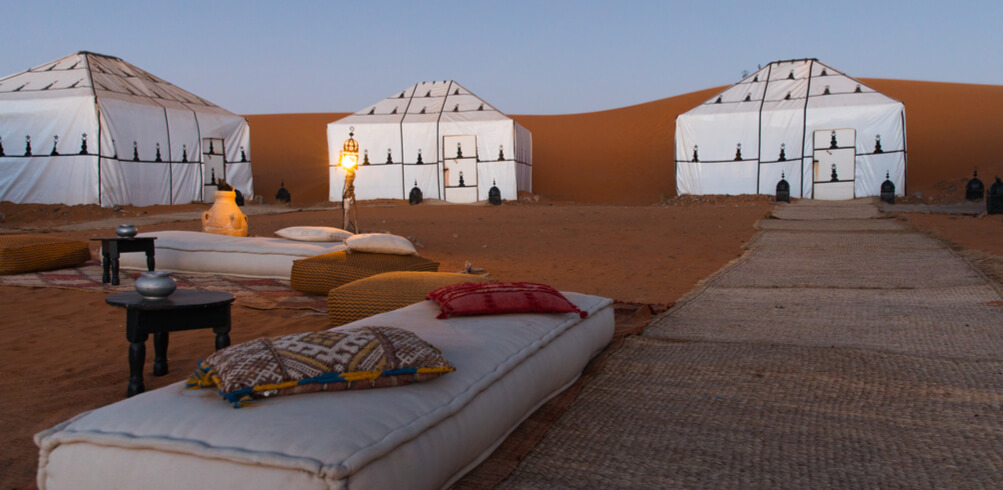
Camping in the Sahara means spending a night in a furnished Berber camp at the edge of Morocco's Erg Chebbi dunes, reached by camel at sunset, with a traditional dinner around the fire and a Milky Way sky overhead.
Morocco is a country of bustling souks, towering minarets, sprawling Kasbahs and aromatic piles of spices at every corner. But of all its drawcards, the Sahara sits at the top of most travellers' lists. A night on the dunes is the country's defining bucket-list moment, and it's far more comfortable than you might expect. Here's what to know before you go.
What camping in the Sahara is really like
Camping in the Sahara is a guided overnight stay in a furnished Berber tent camp pitched among Morocco's towering sand dunes, combining an afternoon camel trek with a traditional dinner, music around the fire, and sunrise over the desert. It is neither roughing it nor budget glamping. Every element, from transfers and camels to camps and meals, is arranged for you.
At a glance:
-
What to expect: a camel ride at dusk, a furnished tent with a proper bed, a Berber feast and a front-row seat to the Milky Way
-
Best time to go: October to April, when daytime temperatures are mild and nights are crisp
-
Where to camp: Erg Chebbi near Merzouga, the most accessible of Morocco's two dune areas
-
Who it's for: travellers drawn to bucket-list experiences who still want comfort at the end of the day
On an Inspiring Vacations tour, every logistical detail is handled, so you arrive ready to enjoy the magic of the Sahara.
The Sahara Desert: Scale, setting and why Morocco
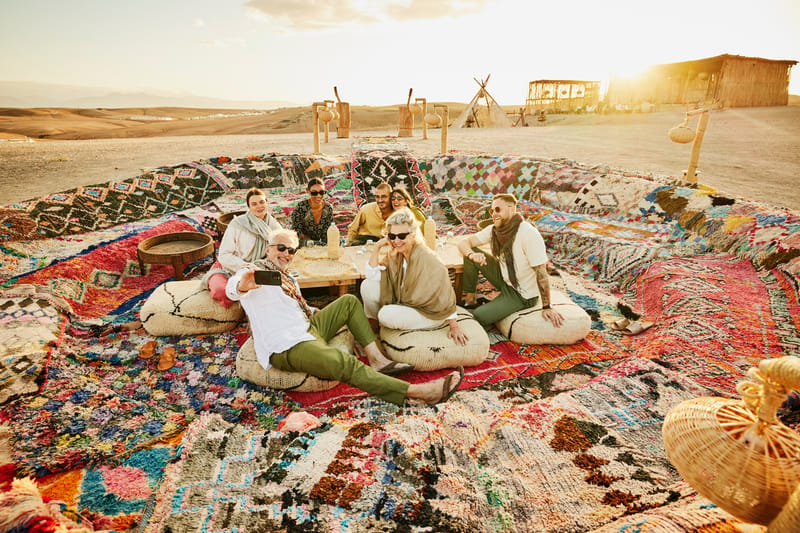
The Sahara is the world's largest hot desert, stretching across 11 countries in North Africa from the Atlantic coast to the Red Sea and covering around 9 million square kilometres (3.5 million square miles). That's more than a quarter of the African continent. In Morocco, the desert sits within reach of the country's imperial cities, which is why so many itineraries pair a Sahara overnight in the Sahara with stops in Marrakech or Fes.
Erg Chebbi vs Erg Chigaga: Which dune area?
Morocco has two main Saharan dune fields, and knowing the difference helps you choose the right itinerary.
-
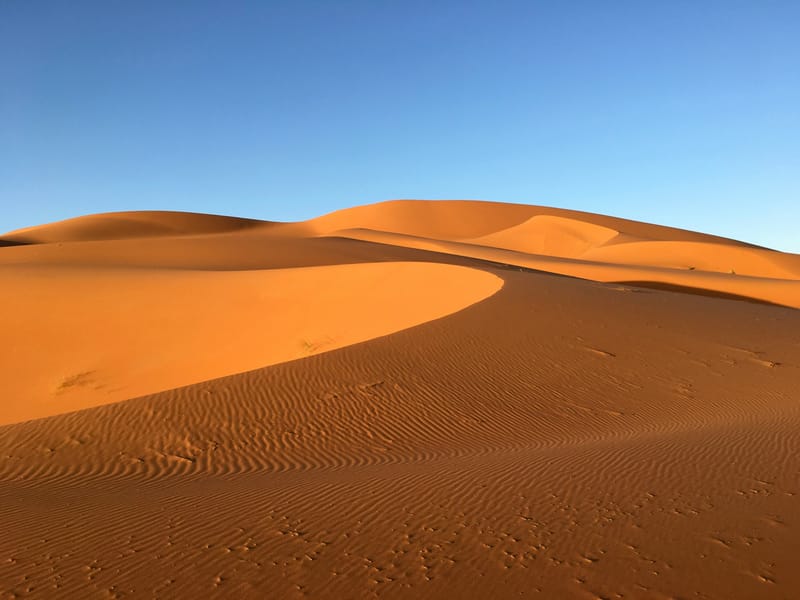
Erg Chebbi: the most popular area, near the oasis town of Merzouga. The dunes are among the tallest in Morocco and the region is easily reached by paved road.
-
Erg Chigaga: a larger, more remote dune field near M'Hamid El Ghizlane, with lower dunes and fewer visitors. Reaching it involves a long 4WD drive or a multi-day camel trek.
For most first-time travellers, Erg Chebbi is the sweet spot: towering dunes, an established camp scene, and a shorter ride in from the nearest town.
The Berber people: Desert life and ancient traditions
The Berbers, or Amazigh (meaning "free people"), are the indigenous peoples of North Africa and have lived in the region for thousands of years, well before the arrival of Arab dynasties. Rock art and ancient inscriptions across the Sahara trace Amazigh presence deep into prehistory.
Tamazight is now an official language of Morocco alongside Arabic, and its distinctive script appears on road signs and government buildings today. It's believed a majority of Moroccans have Amazigh heritage.
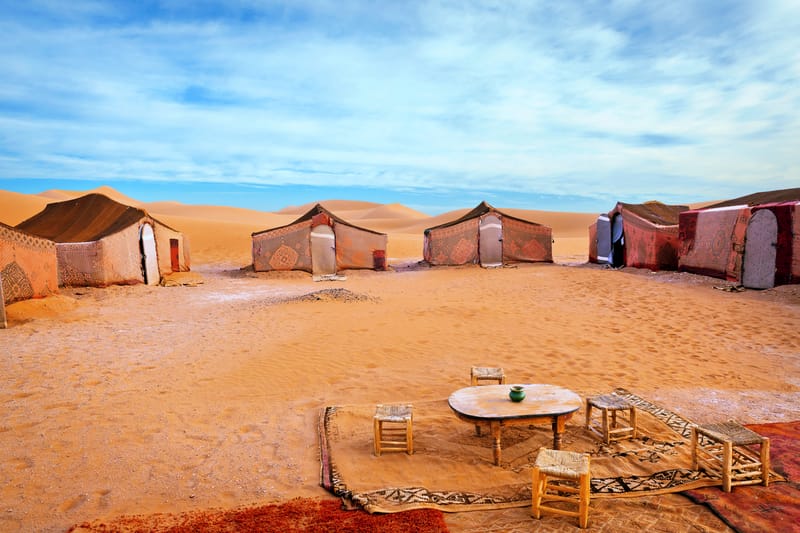
At your desert camp, the people pouring mint tea, leading camels and drumming around the fire are almost always Amazigh. Their hospitality runs centuries deep, and generations of desert knowledge keep every overnight running smoothly. The desert is their home, and you're their guest.
Getting to the Sahara: From Marrakech or Fes to Merzouga
The drive to Merzouga takes around nine to ten hours from Marrakech and about seven hours from Fes, which is why most Morocco itineraries split the drive across two days with an overnight stop.
Along the way, you'll cross the High Atlas Mountains, wind through the palm-lined Draa Valley and pause at the limestone cliffs of Todra Gorge. Many tours also stop at the UNESCO-listed ksar of Aït Benhaddou, the mud-brick fortified village made famous by Gladiator and Game of Thrones.
The camel treks into the dunes
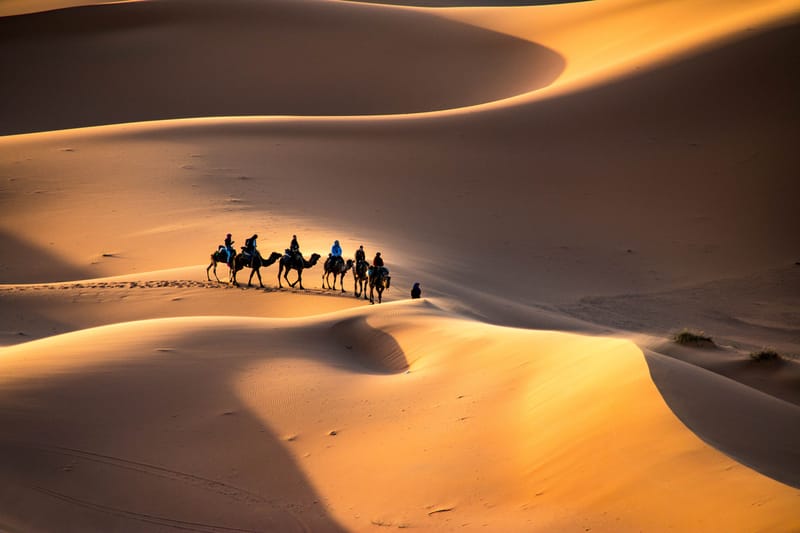
Your desert camping experience begins in Merzouga, a small oasis town where paved road meets endless sand. From the main street, the dunes are already visible, rising golden in the distance. As the sun starts to sink, you'll climb aboard a camel and set off into the Sahara, the animal's slow sway matched by long camel-shaped shadows stretching across the dunes.
The ride typically lasts an hour to ninety minutes. Your Berber guide walks alongside, leading the camels on foot as families have for generations. The shift from warm afternoon to cool evening is dramatic. By the time camp comes into view, the sky is pink, the sand is deep orange, and everything is quiet.
A few practical tips for the ride:
-
Wear long, comfortable pants to prevent chafing on the saddle.
-
Wrap a scarf around your neck or head to keep blown sand out.
-
Bring a camera, but secure it with a strap, as a dropped phone on a dune disappears fast.
-
Pack light. Keep heavy bags at your hotel in Merzouga and take only a small daypack.
Your desert camp: What to expect
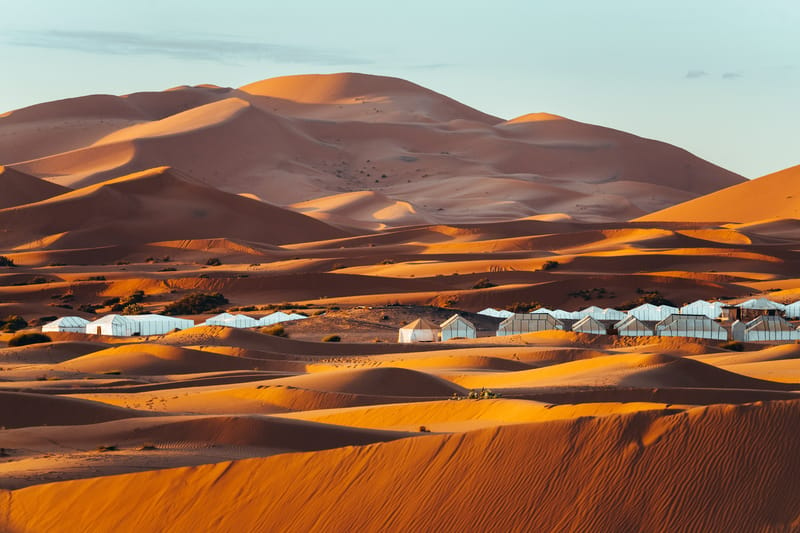
Forget one-person tents and sleeping mats. A Berber desert camp at Erg Chebbi is closer to a boutique hotel than a campsite. Expect proper beds with linen, private bathrooms at many camps, and Moroccan textiles throughout. The layout centres on a communal fire pit, a dining tent and open viewing areas where the dunes roll away in every direction. Morocco's other accommodation styles are just as distinctive, from riads in the medina to kasbahs in the Atlas.
Inspiring Vacations hand-selects camps for comfort and hospitality, so you don't need to compare operators yourself. Your camp is ready, your tent is yours, and someone is already pouring your welcome tea.
Dinner under the stars: Berber food and hospitality
As darkness falls, Berber staff prepare a traditional feast. Expect slow-cooked tagines layered with preserved lemon and olives, fluffy couscous, spiced roast vegetables and warm flatbread. Mint tea is poured from height into a small glass, a Moroccan tradition that cools the drink and creates a light foam on top.
Meals are communal, served from a central dish and eaten around a long table under a canvas roof, and sharing that first course with fellow travellers is where camp life really begins.
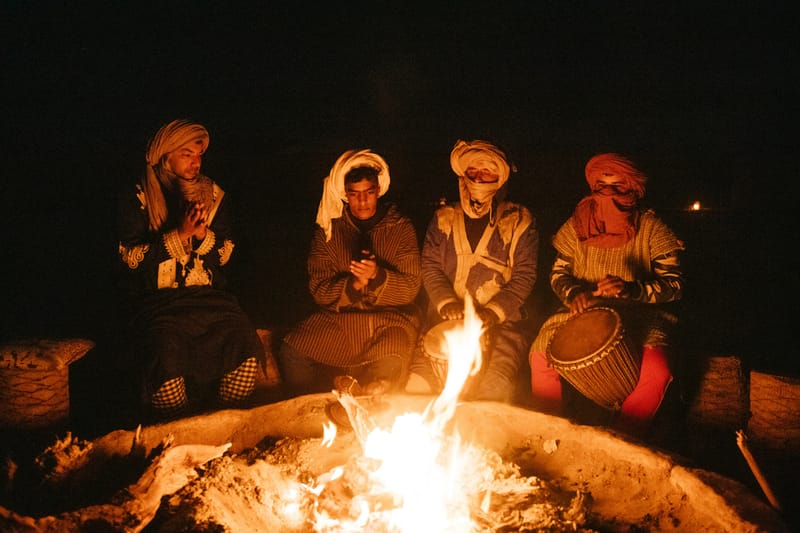
After dinner, follow the fanoos (Moroccan lanterns) to a spot on the sand. Your Berber hosts play drums and sing traditional songs around the fire, and dancing is very much encouraged.
Stargazing in the Sahara: The night sky experience
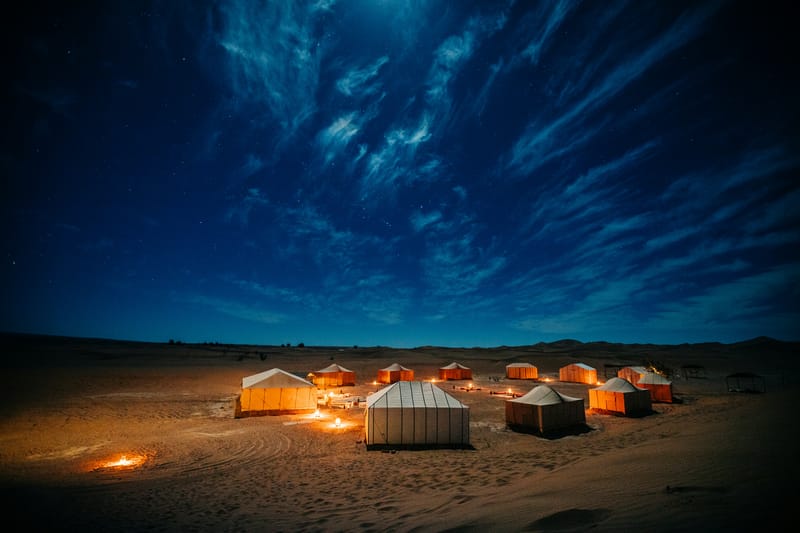
Few places on Earth offer a night sky like the Sahara. With no artificial light for hundreds of kilometres in every direction, the Milky Way stretches in a dense band from horizon to horizon. Major constellations and frequent shooting stars are easy to spot with the naked eye, without binoculars or a telescope.
For the clearest, coolest skies, aim for a visit between October and March, when humidity and haze are at their lowest. Bring a warm layer, lie back on the cool sand and let your eyes adjust for ten minutes. The longer you look, the more appears.
Practical tips for camping in the Sahara Desert
A few things to know before you pack your bag:
-
Best time to visit: October to April. Summers at Erg Chebbi bring searing heat, and many camps close through the hottest months.
-
What to pack: sunscreen, lip balm, a headscarf, layered clothing (nights drop sharply), closed-toe shoes, a power bank and a small daypack.
-
What to leave behind: heavy luggage, high heels and delicate fabrics. Camels carry bags but keep them light.
-
Health considerations: hydrate constantly, reapply sun protection throughout the day, and let your tour provider know about dietary or medical needs in advance.
-
Cultural respect: the desert is the Amazigh home. Ask before photographing people, and follow your guide's lead on camp etiquette.
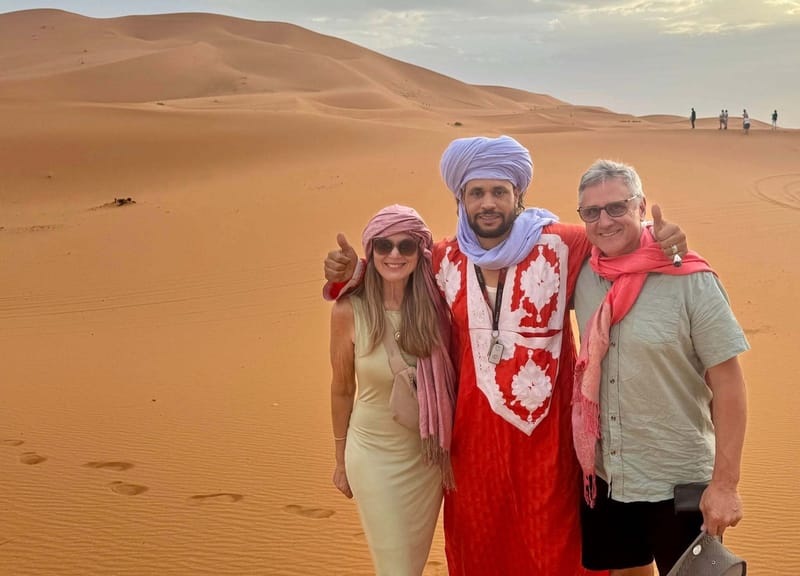
Experience the Sahara with Inspiring Vacations
The Sahara is one of the defining highlights of any Morocco itinerary. Two itineraries that include an overnight in the Sahara are our Magical Morocco and Egypt Premium Small Group tour and our Morocco, Egypt and Jordan Premium Small Group tour. For the full lineup, browse our Morocco tours.
Frequently asked questions
Is camping in the Sahara safe?
Yes. Desert camps at Erg Chebbi are well established, staffed overnight, and run by experienced Berber hosts who have worked the dunes for generations. On a guided Inspiring Vacations tour, your transfers, camels, camps and meals are all arranged in advance, and you travel with a tour leader and a small group of fellow travellers, so you're never on your own out there.
What is the best time of year to camp in the Sahara?
October to April is the ideal window. Daytime temperatures are comfortable, nights are cool but manageable, and skies are at their clearest for stargazing. Summers at Erg Chebbi bring searing heat, and most camps close through the hottest months. March, April, October and November are particularly good for first-time visitors looking for settled weather.
How do you get to the Sahara from Marrakech?
The overland drive from Marrakech to Merzouga takes around nine to ten hours, and most tours break the journey with an overnight stop in the Dades Valley or Ouarzazate. From Fes, the drive is shorter at around seven hours. On an Inspiring Vacations tour, all transfers, en route stops, and accommodation are included, and the drive through the Atlas Mountains becomes part of the Moroccan story.
What should I pack for a Sahara Desert camp?
Pack light, breathable layers for hot days; a warm jacket for cold nights; closed-toe shoes for dune walking; a headscarf; sunscreen; lip balm; a reusable water bottle; and a power bank. Keep your main bag small, as camels carry luggage into camp. Heavy suitcases can stay at your Merzouga hotel. Outside the desert, Morocco's cities and mountains call for layered clothing, modest dress for medina visits and a warmer layer for the Atlas.
Can you camp in the Sahara without a tour?
You can, but most travellers don't. Independent logistics involve arranging transport from Marrakech or Fes, vetting camp operators and coordinating camel handlers. On a guided Inspiring Vacations tour, all of this is taken care of, and you travel with a tour leader and a small group. If you're wondering how to camp in the Sahara with confidence, a guided tour is the simplest way to go.