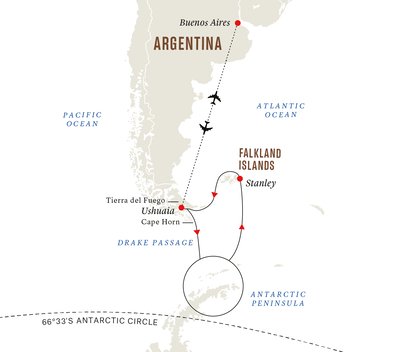
16 Day Antarctica & Falklands Expedition Onboard Ms Roald Amundsen
This tour is categorised as 3 out of 5
Balanced exploration with walking tours: Our most popular style, this tour offers a good mix of planned activities and free time. Expect moderate daily walking tours, so pack comfortable shoes.
As a general requirement across all of our trips, you may be required to walk up and down stairs, get on and off transportation, handle your own luggage, and participate in all scheduled sightseeing that may be conducted on uneven ground and terrain. Any physical ailments you may have must be disclosed at the time of booking to determine your suitability and where required, supporting documentation may be requested to ensure that we are comfortable that you will enjoy your trip.
For the true explorer, expedition small-ship cruising is the best way to get off the beaten track.This experience is not just about the ship’s creature comforts but very much the destination, its nature and wildlife. Daily shore excursions by Zodiac inflatable boats allow you to step onshore and explore. A world-class, expert expedition team will help you discover each exciting destination. Onboard you’ll enjoy informative and educational lectures. These trips will be a mix of fully guided or self-guided depending on your chosen package. There’s a land touring component with shared sightseeing and transfers.
✓ Travel with Hurtigruten
✓ Explore this wild and wonderful frozen continent
✓ See penguins, whales, and seals in their natural habitat
✓ Experience endless ranges of snow-coated mountains
✓ Discover the majesty of the iceberg sculpted by sun, wind, and waves
✓ Experience a beacon for abundant wildlife; whales, seals, seabirds, and penguins
✓ Go on landings ashore, on small boat cruises, kayaking, snowshoeing, camping, and more
✓ Hurtigruten’s ships combine hybrid technology with lowest CO2-footprint possible
✓ Overnight stay in Buenos Aires before the expedition cruise, including breakfast
✓ Return flights in economy class between Buenos Aires and Ushuaia
✓ Transfer from the hotel in Buenos Aires to Buenos Aires airport before the expedition cruise
✓ Transfers between Ushuaia airport and the ship, including a brief tour of the town
✓ Enjoined with English-speaking Expedition Team activities onboard and ashore
✓ Complimentary Wi-Fi onboard
A perfect taste of Hong Kong in just 3 days. Trace the city's storied past on a guided walk through buzzing streets, past the incense-wreathed Man Mo Temple, the heritage halls of Tai Kwun and the famous Mid-Levels Escalator. Lose yourself in its neon-lit streets, harbour views and world-famous flavours.
There’s a beat to Buenos Aires that is unmistakably unique to the capital of Argentina. Ask any who live here and they’ll tell you it is the melting-pot community of locals who imbue the city with such vibrancy. As porteños, ‘the people of the port’, they came from across the globe, bringing a diverse set of cultures with them. The result is an intoxicating blend of romance music, people dancing the tango at almost every opportunity, Maradona-mad football fans, Old World colonial architecture, and flavoursome Latin food.
You’ll be spending one night at a hotel in the city before catching an early flight the next morning. Depending on when you arrive, you might have some time to explore a little of this lively capital. Visit Teatro Colón, a beautiful opera house that dates back to 1908 and then pop into historic Café Tortoni for Paris-inspired coffee and chocolate-dipped churros. Caminito is a colourful street museum in La Boca neighbourhood that features buzzy markets and restaurants that host live folk dance and tango shows. To carry on the party mood late into the night, the posh district of Palermo has bars and boliche clubs aplenty.
If really want to extend your vacation, you can also come a few days early to join our optional Pre-Programme to explore wild Patagonia.
It’s an early start today. We meet in the lobby of the hotel in the morning and head to the airport for our flight to Ushuaia. The capital of Argentina’s Tierra del Fuego province sits on the shores of a bay backed by the snow-coated mountains of the Martial Glacier to the north.Ushuaia claims the dubious title of the world’s southernmost city, although this is contended by two other Chilean cities.
Your basecamp at sea, MS Roald Amundsen, waits in the port here. Once on board, you’ll be introduced to the Expedition Team who will conduct a health and safety briefing. Afterwards, you have some time to tour the ship and to settle in your cabin before we enjoy a welcome dinner together. Your expedition is officially underway!
It takes two days of straight sailing to reach Antarctica. This is a good thing as two days turns out to be just the right amount of time for you to enjoy equal amounts of relaxation and preparation on board the ship.
To make sure you are ready for the days of exploration ahead of you, the Expedition Team will begin a series of insightful lectures over at the Science Center. Each member of the Expedition Team are experts on different subjects and you’ll find them to be walking, talking treasure troves of fascinating stories and information. Listen and learn intriguing facts about the local wildlife as well as what IAATO-approved sustainability protocol to follow if curious penguins or seals come too close. As part of these IAATO guidelines, you’ll learn the importance of wearing our sterilised rubber boots during all Antarctica landings and why we thoroughly vacuum our clothes from any foreign particles beforehand.
You’ll also find that the ship is equipped with all manner of mod cons that add to your comfort. Keep fit in the gym and on the outdoor track circuit. Any aches from your workout can be steamed away in the sauna or massaged by masterful hands in the Wellness Spa. Three onboard restaurants, each with a different culinary concept, will delight your palate while the Explorer Lounge and Bar is the perfect place to chill with a glass of wine or bubbly. Just because an expedition is exciting, it doesn’t mean it can’t be luxurious too!
It takes two days of straight sailing to reach Antarctica. This is a good thing as two days turns out to be just the right amount of time for you to enjoy equal amounts of relaxation and preparation on board the ship.
To make sure you are ready for the days of exploration ahead of you, the Expedition Team will begin a series of insightful lectures over at the Science Center. Each member of the Expedition Team are experts on different subjects and you’ll find them to be walking, talking treasure troves of fascinating stories and information. Listen and learn intriguing facts about the local wildlife as well as what IAATO-approved sustainability protocol to follow if curious penguins or seals come too close. As part of these IAATO guidelines, you’ll learn the importance of wearing our sterilised rubber boots during all Antarctica landings and why we thoroughly vacuum our clothes from any foreign particles beforehand.
You’ll also find that the ship is equipped with all manner of mod cons that add to your comfort. Keep fit in the gym and on the outdoor track circuit. Any aches from your workout can be steamed away in the sauna or massaged by masterful hands in the Wellness Spa. Three onboard restaurants, each with a different culinary concept, will delight your palate while the Explorer Lounge and Bar is the perfect place to chill with a glass of wine or bubbly. Just because an expedition is exciting, it doesn’t mean it can’t be luxurious too!
The landscapes of Antarctica stretch as far as your eyes can see – a beautiful realm preserved by pristine snow and ice. Tabular icebergs, parts of the great shelves tower above the waters while ancient glaciers give birth to blue-hued icebergs that are sculpted by wind and sun. This is another world, devoid of human influence and a haven for wildlife like whales, penguins and seals.
Just as the icescapes of Antarctica change through its seasons, so does its wildlife. For instance, the number and range of species of whale that can be seen here begin to steadily increase from October through to January, reaching their peak in February and March for the best whale-watching opportunities. By this time, the large amount of krill in the waters attract the most whales and the most whale species who come for a veritable feeding frenzy. If you arrive here in November, you might see thousands of penguins courting and building their nests. Those on December sailings may be treated to scenes of heart-meltingly cute penguin chicks whereas March is usually when adolescent penguins mature and learn how to swim. Other birds, which unlike penguins actually fly, vary throughout the summer months. Eager ornithologists will usually see the likes of cormorants, shags, egrets, sheathbills and many more.
You have five days to take in every magical moment and jaw-dropping scenery Antarctica grants you. This could be gazing at distant white mountains during a walk ashore or having a playful pair of Weddell seals surface next to your small explorer boat to take a peek at you with their large inquisitive eyes. Or being in the winning lottery of those who can join optional but weather-dependent activities like kayaking, snowshoeing or even camping. These are the kinds of experiences that await you in Antarctica. Rest assured we plan to make the most of each landing and will choose the best sites from numerous possible locations on the Antarctic Peninsula and its surrounding islands.
Lectures from the Expedition Team will be ongoing as well, be it on board the ship, ashore during landings, or even when navigating the icebergs and ice floes on cruises via small explorer boat. Topics might touch on glaciology and the impact of climate change on the Antarctic ice shelves or chart the cold continent’s history from the whaling era to its present status under an international peace treaty. The team’s insights will prove invaluable to you over the course of your journey, enhancing your sense of discovery a hundredfold.
It might be an idea to talk with the team’s professional wildlife and landscape photographer for a few tricks to improve the quality of your images. These skills will definitely come in handy for a number of Citizen Science programmes that you can choose to engage with. One of these is the HappyWhale project where photos you take of any whales you spot can be uploaded to a global database that helps researchers track the migration patterns and overall health of the population. In this way, aside from being precious memories, all your snaps add up and contribute to the greater good.
The landscapes of Antarctica stretch as far as your eyes can see – a beautiful realm preserved by pristine snow and ice. Tabular icebergs, parts of the great shelves tower above the waters while ancient glaciers give birth to blue-hued icebergs that are sculpted by wind and sun. This is another world, devoid of human influence and a haven for wildlife like whales, penguins and seals.
Just as the icescapes of Antarctica change through its seasons, so does its wildlife. For instance, the number and range of species of whale that can be seen here begin to steadily increase from October through to January, reaching their peak in February and March for the best whale-watching opportunities. By this time, the large amount of krill in the waters attract the most whales and the most whale species who come for a veritable feeding frenzy. If you arrive here in November, you might see thousands of penguins courting and building their nests. Those on December sailings may be treated to scenes of heart-meltingly cute penguin chicks whereas March is usually when adolescent penguins mature and learn how to swim. Other birds, which unlike penguins actually fly, vary throughout the summer months. Eager ornithologists will usually see the likes of cormorants, shags, egrets, sheathbills and many more.
You have five days to take in every magical moment and jaw-dropping scenery Antarctica grants you. This could be gazing at distant white mountains during a walk ashore or having a playful pair of Weddell seals surface next to your small explorer boat to take a peek at you with their large inquisitive eyes. Or being in the winning lottery of those who can join optional but weather-dependent activities like kayaking, snowshoeing or even camping. These are the kinds of experiences that await you in Antarctica. Rest assured we plan to make the most of each landing and will choose the best sites from numerous possible locations on the Antarctic Peninsula and its surrounding islands.
Lectures from the Expedition Team will be ongoing as well, be it on board the ship, ashore during landings, or even when navigating the icebergs and ice floes on cruises via small explorer boat. Topics might touch on glaciology and the impact of climate change on the Antarctic ice shelves or chart the cold continent’s history from the whaling era to its present status under an international peace treaty. The team’s insights will prove invaluable to you over the course of your journey, enhancing your sense of discovery a hundredfold.
It might be an idea to talk with the team’s professional wildlife and landscape photographer for a few tricks to improve the quality of your images. These skills will definitely come in handy for a number of Citizen Science programmes that you can choose to engage with. One of these is the HappyWhale project where photos you take of any whales you spot can be uploaded to a global database that helps researchers track the migration patterns and overall health of the population. In this way, aside from being precious memories, all your snaps add up and contribute to the greater good.
The landscapes of Antarctica stretch as far as your eyes can see – a beautiful realm preserved by pristine snow and ice. Tabular icebergs, parts of the great shelves tower above the waters while ancient glaciers give birth to blue-hued icebergs that are sculpted by wind and sun. This is another world, devoid of human influence and a haven for wildlife like whales, penguins and seals.
Just as the icescapes of Antarctica change through its seasons, so does its wildlife. For instance, the number and range of species of whale that can be seen here begin to steadily increase from October through to January, reaching their peak in February and March for the best whale-watching opportunities. By this time, the large amount of krill in the waters attract the most whales and the most whale species who come for a veritable feeding frenzy. If you arrive here in November, you might see thousands of penguins courting and building their nests. Those on December sailings may be treated to scenes of heart-meltingly cute penguin chicks whereas March is usually when adolescent penguins mature and learn how to swim. Other birds, which unlike penguins actually fly, vary throughout the summer months. Eager ornithologists will usually see the likes of cormorants, shags, egrets, sheathbills and many more.
You have five days to take in every magical moment and jaw-dropping scenery Antarctica grants you. This could be gazing at distant white mountains during a walk ashore or having a playful pair of Weddell seals surface next to your small explorer boat to take a peek at you with their large inquisitive eyes. Or being in the winning lottery of those who can join optional but weather-dependent activities like kayaking, snowshoeing or even camping. These are the kinds of experiences that await you in Antarctica. Rest assured we plan to make the most of each landing and will choose the best sites from numerous possible locations on the Antarctic Peninsula and its surrounding islands.
Lectures from the Expedition Team will be ongoing as well, be it on board the ship, ashore during landings, or even when navigating the icebergs and ice floes on cruises via small explorer boat. Topics might touch on glaciology and the impact of climate change on the Antarctic ice shelves or chart the cold continent’s history from the whaling era to its present status under an international peace treaty. The team’s insights will prove invaluable to you over the course of your journey, enhancing your sense of discovery a hundredfold.
It might be an idea to talk with the team’s professional wildlife and landscape photographer for a few tricks to improve the quality of your images. These skills will definitely come in handy for a number of Citizen Science programmes that you can choose to engage with. One of these is the HappyWhale project where photos you take of any whales you spot can be uploaded to a global database that helps researchers track the migration patterns and overall health of the population. In this way, aside from being precious memories, all your snaps add up and contribute to the greater good.
The landscapes of Antarctica stretch as far as your eyes can see – a beautiful realm preserved by pristine snow and ice. Tabular icebergs, parts of the great shelves tower above the waters while ancient glaciers give birth to blue-hued icebergs that are sculpted by wind and sun. This is another world, devoid of human influence and a haven for wildlife like whales, penguins and seals.
Just as the icescapes of Antarctica change through its seasons, so does its wildlife. For instance, the number and range of species of whale that can be seen here begin to steadily increase from October through to January, reaching their peak in February and March for the best whale-watching opportunities. By this time, the large amount of krill in the waters attract the most whales and the most whale species who come for a veritable feeding frenzy. If you arrive here in November, you might see thousands of penguins courting and building their nests. Those on December sailings may be treated to scenes of heart-meltingly cute penguin chicks whereas March is usually when adolescent penguins mature and learn how to swim. Other birds, which unlike penguins actually fly, vary throughout the summer months. Eager ornithologists will usually see the likes of cormorants, shags, egrets, sheathbills and many more.
You have five days to take in every magical moment and jaw-dropping scenery Antarctica grants you. This could be gazing at distant white mountains during a walk ashore or having a playful pair of Weddell seals surface next to your small explorer boat to take a peek at you with their large inquisitive eyes. Or being in the winning lottery of those who can join optional but weather-dependent activities like kayaking, snowshoeing or even camping. These are the kinds of experiences that await you in Antarctica. Rest assured we plan to make the most of each landing and will choose the best sites from numerous possible locations on the Antarctic Peninsula and its surrounding islands.
Lectures from the Expedition Team will be ongoing as well, be it on board the ship, ashore during landings, or even when navigating the icebergs and ice floes on cruises via small explorer boat. Topics might touch on glaciology and the impact of climate change on the Antarctic ice shelves or chart the cold continent’s history from the whaling era to its present status under an international peace treaty. The team’s insights will prove invaluable to you over the course of your journey, enhancing your sense of discovery a hundredfold.
It might be an idea to talk with the team’s professional wildlife and landscape photographer for a few tricks to improve the quality of your images. These skills will definitely come in handy for a number of Citizen Science programmes that you can choose to engage with. One of these is the HappyWhale project where photos you take of any whales you spot can be uploaded to a global database that helps researchers track the migration patterns and overall health of the population. In this way, aside from being precious memories, all your snaps add up and contribute to the greater good.
The landscapes of Antarctica stretch as far as your eyes can see – a beautiful realm preserved by pristine snow and ice. Tabular icebergs, parts of the great shelves tower above the waters while ancient glaciers give birth to blue-hued icebergs that are sculpted by wind and sun. This is another world, devoid of human influence and a haven for wildlife like whales, penguins and seals.
Just as the icescapes of Antarctica change through its seasons, so does its wildlife. For instance, the number and range of species of whale that can be seen here begin to steadily increase from October through to January, reaching their peak in February and March for the best whale-watching opportunities. By this time, the large amount of krill in the waters attract the most whales and the most whale species who come for a veritable feeding frenzy. If you arrive here in November, you might see thousands of penguins courting and building their nests. Those on December sailings may be treated to scenes of heart-meltingly cute penguin chicks whereas March is usually when adolescent penguins mature and learn how to swim. Other birds, which unlike penguins actually fly, vary throughout the summer months. Eager ornithologists will usually see the likes of cormorants, shags, egrets, sheathbills and many more.
You have five days to take in every magical moment and jaw-dropping scenery Antarctica grants you. This could be gazing at distant white mountains during a walk ashore or having a playful pair of Weddell seals surface next to your small explorer boat to take a peek at you with their large inquisitive eyes. Or being in the winning lottery of those who can join optional but weather-dependent activities like kayaking, snowshoeing or even camping. These are the kinds of experiences that await you in Antarctica. Rest assured we plan to make the most of each landing and will choose the best sites from numerous possible locations on the Antarctic Peninsula and its surrounding islands.
Lectures from the Expedition Team will be ongoing as well, be it on board the ship, ashore during landings, or even when navigating the icebergs and ice floes on cruises via small explorer boat. Topics might touch on glaciology and the impact of climate change on the Antarctic ice shelves or chart the cold continent’s history from the whaling era to its present status under an international peace treaty. The team’s insights will prove invaluable to you over the course of your journey, enhancing your sense of discovery a hundredfold.
It might be an idea to talk with the team’s professional wildlife and landscape photographer for a few tricks to improve the quality of your images. These skills will definitely come in handy for a number of Citizen Science programmes that you can choose to engage with. One of these is the HappyWhale project where photos you take of any whales you spot can be uploaded to a global database that helps researchers track the migration patterns and overall health of the population. In this way, aside from being precious memories, all your snaps add up and contribute to the greater good.
Even though you might have to tear yourself away from Antarctica, our time there will come to an end and we will have to point the ship north again. The following two days at sea back across the Drake Passage can be spent sorting through all your amazing photos of Antarctica, and making sure you still have space on your memory card for what’s to come next. You might also have the option to join workshops where you’ll channel your memories of Antarctica to paint penguins or learn how to tie complicated sailor’s knots.
Over at the Science Center, there will likely be presentations from the Expedition Team to stir your enthusiasm for the final few days of your voyage in the Falkland Islands. Lectures may include the tense history of the islands as well as the species of birds that can be seen around its beautiful beaches. In between lectures, you can use the Science Centre’s advanced microscopes to peer into water samples at a cellular level. You’ll discover all manner of microscopic lifeforms including krill and phytoplankton, which also happen to tie into another Citizen Science initiative.
Even though you might have to tear yourself away from Antarctica, our time there will come to an end and we will have to point the ship north again. The following two days at sea back across the Drake Passage can be spent sorting through all your amazing photos of Antarctica, and making sure you still have space on your memory card for what’s to come next. You might also have the option to join workshops where you’ll channel your memories of Antarctica to paint penguins or learn how to tie complicated sailor’s knots.
Over at the Science Center, there will likely be presentations from the Expedition Team to stir your enthusiasm for the final few days of your voyage in the Falkland Islands. Lectures may include the tense history of the islands as well as the species of birds that can be seen around its beautiful beaches. In between lectures, you can use the Science Centre’s advanced microscopes to peer into water samples at a cellular level. You’ll discover all manner of microscopic lifeforms including krill and phytoplankton, which also happen to tie into another Citizen Science initiative.
The far-flung Falkland archipelago is split between the two main islands of East and West Falkland and nearly 800 smaller islands. Sovereignty over the islands has been claimed by both the UK and by Argentina for many years, but at least both sides can agree that these islands are well worth arguing over, and for good reason.
Like our approach in Antarctica, your three days of exploration here and the exact landing sites for each day will be determined by local conditions at the time. After the barren white scenery of Antarctica, you might be a little relieved to see grassy hills, blooming wildflowers, stunning white-sand beaches and turquoise waters. Still, it won’t be too dissimilar in that there are several thousand penguins here for you to catch sight of too! Over these few days, we will try and see colonies of penguins, which often have families of fur seals mixed in among them too. We will be keeping a safe distance so as not to disturb them or their tuxedoed neighbours.
For the first time in more than a week, you’ll also encounter signs of civilisation again, be it the family-owned farms scattered around or the capital of Stanley on East Falkland where four fifths of the islands’ population live. When you visit, you’ll find the town is a slice of English life, including typical red buses and good ol’ pubs serving up British beer and friendly banter.
The far-flung Falkland archipelago is split between the two main islands of East and West Falkland and nearly 800 smaller islands. Sovereignty over the islands has been claimed by both the UK and by Argentina for many years, but at least both sides can agree that these islands are well worth arguing over, and for good reason.
Like our approach in Antarctica, your three days of exploration here and the exact landing sites for each day will be determined by local conditions at the time. After the barren white scenery of Antarctica, you might be a little relieved to see grassy hills, blooming wildflowers, stunning white-sand beaches and turquoise waters. Still, it won’t be too dissimilar in that there are several thousand penguins here for you to catch sight of too! Over these few days, we will try and see colonies of penguins, which often have families of fur seals mixed in among them too. We will be keeping a safe distance so as not to disturb them or their tuxedoed neighbours.
For the first time in more than a week, you’ll also encounter signs of civilisation again, be it the family-owned farms scattered around or the capital of Stanley on East Falkland where four fifths of the islands’ population live. When you visit, you’ll find the town is a slice of English life, including typical red buses and good ol’ pubs serving up British beer and friendly banter.
The far-flung Falkland archipelago is split between the two main islands of East and West Falkland and nearly 800 smaller islands. Sovereignty over the islands has been claimed by both the UK and by Argentina for many years, but at least both sides can agree that these islands are well worth arguing over, and for good reason.
Like our approach in Antarctica, your three days of exploration here and the exact landing sites for each day will be determined by local conditions at the time. After the barren white scenery of Antarctica, you might be a little relieved to see grassy hills, blooming wildflowers, stunning white-sand beaches and turquoise waters. Still, it won’t be too dissimilar in that there are several thousand penguins here for you to catch sight of too! Over these few days, we will try and see colonies of penguins, which often have families of fur seals mixed in among them too. We will be keeping a safe distance so as not to disturb them or their tuxedoed neighbours.
For the first time in more than a week, you’ll also encounter signs of civilisation again, be it the family-owned farms scattered around or the capital of Stanley on East Falkland where four fifths of the islands’ population live. When you visit, you’ll find the town is a slice of English life, including typical red buses and good ol’ pubs serving up British beer and friendly banter.
Your expedition is fast approaching its end. There’s just one last day at sea to enjoy as you wish. Head to the bar and share a few drinks with the friends you have made during your journey. Swap stories of your adventures with the Expedition Team and learn more about these modern-day explorers. Treat yourself to a fine dining experience in the à la carte restaurant or a soothing treatment in the Wellness Spa. Or simply spend time relaxing out on deck, watching the waves and fondly remembering the many highlights of your voyage.
After two weeks enjoying exploring Antarctica and the Falklands, we dock back in Ushuaia. It’s been an epic and emotional journey and we’ll have seen and learned so much together. There might even be a few tears when we come to bid each other farewell.
It is our hope that your experience with us will have left a lasting impression about what is possible when expeditions are done in a sustainable way. May each of us continue to do all we can to protect these precious habitats and the wonderful wildlife that live in them.
Transferring to Ushuaia airport, you’ll fly back to Buenos Aires. From there, you will either fly home or continue to explore more. Seeing as you are already in Argentina, you might like to make the most of it! Why not join an optional Post-Programme to the magnificent Iguazu waterfalls?
Cabin Bedding and Upgrades
Bedding on board the cruise is restricted to the following configurations. If you wish to upgrade your cabin, the following amounts are payable in addition to the package price prior to travel:
Polar Outside (RR): INCLUDED
Our Polar Outside cabins are mostly situated on the middle or lower decks and have a bathroom with a shower. These cabins also have a queen bed or separate beds. Each Polar Outside cabin has its own unique specifications.
Arctic Superior (TY)
Relaxation and comfort are hallmarks of the Arctic Superior cabins. Situated on both the upper and middle decks, the cabins all have a bathroom with a shower. Most have a queen bed, while some have separate beds. Each Arctic Superior cabin has its own unique specifications. Upgrades from AU$1,119 per person, twin share or AU$3,138 per person, single (subject to availability).
Expedition Suite (ME)
Our Expedition Suites are the most luxurious cabins on the ship. Situated on the upper decks of the ship, these cabins feature seating areas with a TV, a bathroom with a shower, and a queen bed. Each Expedition Suite has its own unique specifications. Upgrades from AU$2,347 per person, twin share or AU$15,787 per person, single (subject to availability).
Please request your cabin upgrade in the 'special requests' field. Availability and price will then be confirmed and added to your invoice upon acceptance.
MS Roald Amundsen is The very first of our revolutionary hybrid-powered expedition vessels with battery packs that store electric power. This ship has more efficient engines, lower fuel usage, reduced C02 emissions, and the ability to sail almost silently.
Welcome to the future of sustainable expedition cruising. We’ve designed every element of our new ships to enhance your journey and create a warm and informal atmosphere. Join us in premium onboard surroundings as we explore some of the most beautiful places on Earth
to know more about your ship, click HERE.
Onboard Features
Hotel
Flights
Transfers
Expedition Cruise
Onboard Activities
Landing Activities
Notes
Deposit & Payments
Booking Process
Booking On Request
COVID-19
Due to COVID there maybe disruptions to standard operating schedules of particular components of this itinerary. Should a component be effected a substitute will be confirmed prior to departure.
Fitness Requirements
While the tour itinerary should give you some guidance and overview to the expected requirements, to determine if this tour is right for you we categorise each of our tours in terms of their intensity.
These guidelines are to ensure that each tour group is conducted as expected and to ensure the overall satisfaction of all Inspiring Vacations customers. As a general rule, porterage is not included, therefore at all times you are expected to handle your own luggage where help may not be available.
Accommodation
The accommodation listed is subject to change. Any changes will be of an equal or higher standard. Bedding configurations (double or twin) are requests only and subject to availability. All efforts will be made to meet your preferences, however any changes are beyond our control.
Single Supplement
Please follow the 'book now' prompts and select 1 passenger to view the single supplement cost.
Triple Share
Not Available
Travel Insurance
Travel insurance is required to protect yourself against the unexpected.
Visa & Passport information
It is the traveler's responsibility to ensure they have a valid passport. The passport must be valid for a minimum of six months from the intended date of return.
Visas may be required.
Please note that these details are subject to change without notice. We recommend visiting https://www.safetravel.govt.nz for up-to-date information in terms of entry requirements.
Tour Documentation
Final documentation including, e-tickets and cruise details, will be provided approximately 30 days prior to travel.
Children
Children must share a room with parents at all times and are charged the same price as adults.
For all international voyages, it is the traveller's responsibility to ensure that they have a valid passport and they meet the visa requirement. The passport must be valid for a minimum of six months from the intended date of return.




 Australia
 United States
 Canada