✓ Travel with Hurtigruten
✓ Explore this wild and wonderful frozen continent and see penguins, whales and seals in their natural habitat
✓ See endless ranges of snow-coated mountains and the majesty of iceberg sculpted by sun, wind, and waves.
✓ The krill-rich waters are a beacon for abundant wildlife; whales, seals, seabirds and of course, penguins.
✓ Visitors can go on landings ashore, on small boat cruises, kayaking, snowshoeing, camping, and maybe even a polar plunge.
✓ Hurtigruten’s ships to Antarctica combine hybrid technology, helping us have the lowest possible CO2-footprint as possible.
✓ 2 overnights in Santiago de Chile. before and after the cruise
✓ Transfer from your hotel in Santiago de Chile to the ship, before the expedition cruise
✓ Transfer from the ship to Punta Arenas airport, after the expedition cruise
✓ English-speaking Expedition Team who organise and accompany activities on board and ashore
✓ Complimentary Wi-Fi on board
Travel with the experts for a carefully curated, value-packed discovery of the world's most iconic destinations. Our tours are bursting with must-see sights, rich experiences and quality inclusions, all at an unbeatable price. Bucket list dreams are ticked off on these all-encompassing journeys.
After your flight from Australia or New Zealand, arrive in Santiago de Chile and be transferred to your hotel. The rest of the day is at your leisure.
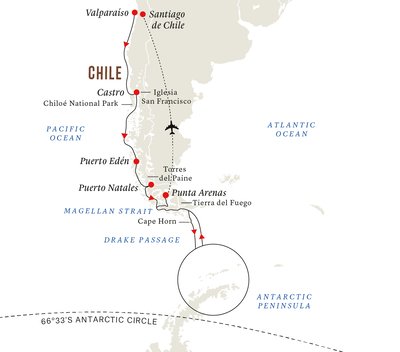
Your adventure starts in Valparaíso, also called ‘Valpo’ for short by the locals. This was once a major seaport for ships crossing between the Atlantic and Pacific Oceans, but with the opening of the Panama Canal in 1914, that golden age of commerce came to a halt. But if you take a stroll along the port before embarking on MS Fram, Polar Outside, you will definitely get a feel for its old greatness.
Thankfully, the city has much more going for it. A diverse arts scene, thriving foodie culture, vintage funiculars and hill-top neighbourhoods covered in colourful houses means it has enviable comparisons with San Francisco. Alegre district seems to encapsulate each one of those elements. Hop between the cafés and restaurants here and enjoy viewsover the city and nearby sea. Make sure you alsovisit the UNESCO-listed Historic Quarter where you can admire beautiful buildings and street art
Your expedition cruise has finally begun, and you can enjoy two days of sailing along the scenic Pacific coast of Chile. Spending your days on deck as we glide by the exceptionalscenery is always a good idea. You might even spot wildlife such as migrating whales and even albatross. This is also when the Expedition Team start their lecture programme to prepare you for the experiences that await you.
Learn about the science, the wildlife and thehistory of the area, and take part in Citizen Science projects in the Science Center. You can also attend art classes where you among other things can draw or sculpt your favourite penguin. There is always plenty to do. And if you don’t really want to do anything, the Explorer Lounge & Bar is the perfect place for doing – or rather not doing – just that.
Your expedition cruise has finally begun, and you can enjoy two days of sailing along the scenic Pacific coast of Chile. Spending your days on deck as we glide by the exceptionalscenery is always a good idea. You might even spot wildlife such as migrating whales and even albatross. This is also when the Expedition Team start their lecture programme to prepare you for the experiences that await you.
Learn about the science, the wildlife and thehistory of the area, and take part in Citizen Science projects in the Science Center. You can also attend art classes where you among other things can draw or sculpt your favourite penguin. There is always plenty to do. And if you don’t really want to do anything, the Explorer Lounge & Bar is the perfect place for doing – or rather not doing – just that.
Castro is the capital of Chiloé Island, set among windswept hills and green vegetation. Most visitors immediately make a beeline to the wharfat Gamboa district to seebrightly painted wooden houses, called ‘palafitos’, mounted on stilts along theFiordo de Castro. But this little big city has more to offer. If you head down to the central town square, you can visit the UNESCO World Heritage Site Iglesia San Francisco, an old wooden Neo-Gothic church that dates back tothe founding of the city in 1567. If you fancy something more modern, the Museum of Modern Art of Chiloé is also worth a visit. And should you get hungry on your way through town, there are many great restaurants here, making Castro a surprisingly culinary destination.
We continue south, making our way through the fabled waters of Patagonia. When Magellan sailed here in 1520, he used the term ‘patagon’ to describe the indigenous tribes of the region, which he and his expedition believed to be giants of up to 5 metres tall. While we can’t promise you giants, the iconic Andean seascapes of undisturbed nature and spectacular mountain peaks are definitely both great and grand.
We are getting closer to one of the world’s most remote and beautiful places; the province of Última Esperanza, meaning Last Hope. Spanish navigator Juan Ladrillero named it so in 1557 after several failed attempts to reach the Strait of Magellan. You’ll be happy to know that he did go on to successfully find and navigate the strait.
The mini-village of Puerto Edénsits on a bay, on the edge of a peninsula, in the middle of a fjord in Bernardo O´Higgins National Park. The comparisons to the Garden of Eden apply more to the park than to the hamlet itself, but, needless to say, this place is hard to get to. While the surrounds are certainly a paradise off the beaten path, there are actually no roads that lead here and Puerto Edén is only accessible by sea.
However, the isolation suits the dozen indigenous Kawéskar people who gave up their canoe-faring nomadic lifestyle to settle here a generation ago. And because of the unusually humid climate and high rainfall, there are no roadsaround the hamlet either. To move around and visit the small arts and crafts shops, you must use the pedestrian boardwalks that connect the houses and buildings of the 250 people living here.
Thanks to its proximity to Torres del Paine National Park, Puerto Natales has swapped the sheep from its former agricultural industry for fleece-wearing hikers who stream here for a Patagonian adventure. You’ll see many corrugated tin shops catering to this new clientele, stocking up on all sorts of outdoor clothing and offering an increasingly diverse selection of cuisine.
Over the two days we spend here, you’ll have the option to join an excursion to the park itself or to enjoy the atmosphere and attractions of Puerto Natales. Go for drinks at one of the many quiet bars and chat to locals and other international adventurers. The Last Hope is both bar and gin distillery and reputedly the southernmost distillery in the world. Strolling along the waterfront next to Última Esperanza fjord, you’ll likely take photos at the old pier and a few other monuments dotted on the way.
Thanks to its proximity to Torres del Paine National Park, Puerto Natales has swapped the sheep from its former agricultural industry for fleece-wearing hikers who stream here for a Patagonian adventure. You’ll see many corrugated tin shops catering to this new clientele, stocking up on all sorts of outdoor clothing and offering an increasingly diverse selection of cuisine.
Over the two days we spend here, you’ll have the option to join an excursion to the park itself or to enjoy the atmosphere and attractions of Puerto Natales. Go for drinks at one of the many quiet bars and chat to locals and other international adventurers. The Last Hope is both bar and gin distillery and reputedly the southernmost distillery in the world. Strolling along the waterfront next to Última Esperanza fjord, you’ll likely take photos at the old pier and a few other monuments dotted on the way.
Glacial ice once scoured its way through the landscapes, creating the deep and beautiful Chilean fjords and canals and the tall mountains that surround them. Even though the area seems almost untouched by humans, these canals have been used for fishing and hunting by the canoe-faring indigenous people for centuries.
Now you can enjoy the serenity of this maze of waterways between islands, mountains and glaciers. Iftime and weather permit, you might be taken on a scenic cruising of the fjords aboard our small explorer boats or join a landing ashore.Keep your eyes on the sky to look for birds following the ship. In the water, you might get to see dolphins andeven whales.
In the morning, we will sail through the scenic Beagle Channel, where you can watch for rare, endemic Peale’s dolphin and other wildlife. Once we exit the channel, we journey down to Cape Horn. This headland on Hornos Island was discovered in 1616 by the Dutchman Willem Schouten, who named it Kaap Hoorn after the city of Hoorn in the Netherlands. The waters around the capeare typically choppy with strong wind and large waves and therefore rarely favourable for landings. If, however, the weather allows us to land on the island and go up to the cape, it will surely be something to remember.
When we enter the Drake Passage, our Expedition Team will continue their lectures, providing food for thoughttofurther prepare you for your adventure ahead. You will learn how to make your visit in Antarctica as safe and sustainable as possible by reviewing key IAATO guidelines.The team might cover the sterilisation procedure for our special shore boots or why we always vacuum our clothes and backpack before we go on landings in Antarctica.For better photos, our onboard photographer will tell you how to adjust the white balance and when best to reduce the exposure. Stay active in the gym or soothe in the sauna but don’t forget to scan the horizon out on deck or in the Explorer Lounge for signs of that first iceberg.
In the morning, we will sail through the scenic Beagle Channel, where you can watch for rare, endemic Peale’s dolphin and other wildlife. Once we exit the channel, we journey down to Cape Horn. This headland on Hornos Island was discovered in 1616 by the Dutchman Willem Schouten, who named it Kaap Hoorn after the city of Hoorn in the Netherlands. The waters around the capeare typically choppy with strong wind and large waves and therefore rarely favourable for landings. If, however, the weather allows us to land on the island and go up to the cape, it will surely be something to remember.
When we enter the Drake Passage, our Expedition Team will continue their lectures, providing food for thoughttofurther prepare you for your adventure ahead. You will learn how to make your visit in Antarctica as safe and sustainable as possible by reviewing key IAATO guidelines.The team might cover the sterilisation procedure for our special shore boots or why we always vacuum our clothes and backpack before we go on landings in Antarctica.For better photos, our onboard photographer will tell you how to adjust the white balance and when best to reduce the exposure. Stay active in the gym or soothe in the sauna but don’t forget to scan the horizon out on deck or in the Explorer Lounge for signs of that first iceberg.
This is the final frozen frontier; an unspoilt, vast, white desert teeming with life at the bottom of the world. Majestic mountains rise up from the icy sea, coated in thick snow. Glaciers creep across the landscape, cracking and calving icebergs along the coast. The scenery is almost silent, save for the shrill of lovesick penguins, splashes from courting seals, and the sound of crumbling ice.The 46 species of birds living here, like terns, petrels and jaegers may also take up a lot of your attention.
During the seven days we spend around the South Shetland Islands and Antarctic Peninsula, we will likelygo ashoreat several places, allowing you to experience the region’s wildlife and landscapes first-hand. The Expedition Team will lead on landings where they will create a perimeter for you to move around freely at your own speed. They will also direct ice-cruising in our small expedition boats to tour icebergs and glaciers from a safe distance.Added to that, there are sometimes optional activities like kayaking, camping and snowshoeing which you may be lucky enough to join in on. You can also take part in a varied choice of Citizen Science projects like photographing whales and collecting water samples. Uploading your photos to a global database helps scientists around the world to study migration patterns and microbiology. You will get an even better understanding of the fragile ecosystem of Antarctica when we study the samples in the Science Center.
As outlined in the Antarctic Treaty, Antarctica is dedicated to peace, science and tourism. That’s why we adhere to very strict environmental guidelines in this area. We are the foreign element here, so it is important to make as little impact as possible. The wildlife is used to the ice and cold weather, but not human interference. We want to leave nothing but footprints and take nothing but pictures! In fact, in many of the areas we visit, we even wipe out our footprints to prevent penguins falling into them and getting stuck. Being Antarctic ambassadors, we want future explorers to have the same experience you have when it is their turn to be amazed by this pristine continent.
This is the final frozen frontier; an unspoilt, vast, white desert teeming with life at the bottom of the world. Majestic mountains rise up from the icy sea, coated in thick snow. Glaciers creep across the landscape, cracking and calving icebergs along the coast. The scenery is almost silent, save for the shrill of lovesick penguins, splashes from courting seals, and the sound of crumbling ice.The 46 species of birds living here, like terns, petrels and jaegers may also take up a lot of your attention.
During the seven days we spend around the South Shetland Islands and Antarctic Peninsula, we will likelygo ashoreat several places, allowing you to experience the region’s wildlife and landscapes first-hand. The Expedition Team will lead on landings where they will create a perimeter for you to move around freely at your own speed. They will also direct ice-cruising in our small expedition boats to tour icebergs and glaciers from a safe distance.Added to that, there are sometimes optional activities like kayaking, camping and snowshoeing which you may be lucky enough to join in on. You can also take part in a varied choice of Citizen Science projects like photographing whales and collecting water samples. Uploading your photos to a global database helps scientists around the world to study migration patterns and microbiology. You will get an even better understanding of the fragile ecosystem of Antarctica when we study the samples in the Science Center.
As outlined in the Antarctic Treaty, Antarctica is dedicated to peace, science and tourism. That’s why we adhere to very strict environmental guidelines in this area. We are the foreign element here, so it is important to make as little impact as possible. The wildlife is used to the ice and cold weather, but not human interference. We want to leave nothing but footprints and take nothing but pictures! In fact, in many of the areas we visit, we even wipe out our footprints to prevent penguins falling into them and getting stuck. Being Antarctic ambassadors, we want future explorers to have the same experience you have when it is their turn to be amazed by this pristine continent.
This is the final frozen frontier; an unspoilt, vast, white desert teeming with life at the bottom of the world. Majestic mountains rise up from the icy sea, coated in thick snow. Glaciers creep across the landscape, cracking and calving icebergs along the coast. The scenery is almost silent, save for the shrill of lovesick penguins, splashes from courting seals, and the sound of crumbling ice.The 46 species of birds living here, like terns, petrels and jaegers may also take up a lot of your attention.
During the seven days we spend around the South Shetland Islands and Antarctic Peninsula, we will likelygo ashoreat several places, allowing you to experience the region’s wildlife and landscapes first-hand. The Expedition Team will lead on landings where they will create a perimeter for you to move around freely at your own speed. They will also direct ice-cruising in our small expedition boats to tour icebergs and glaciers from a safe distance.Added to that, there are sometimes optional activities like kayaking, camping and snowshoeing which you may be lucky enough to join in on. You can also take part in a varied choice of Citizen Science projects like photographing whales and collecting water samples. Uploading your photos to a global database helps scientists around the world to study migration patterns and microbiology. You will get an even better understanding of the fragile ecosystem of Antarctica when we study the samples in the Science Center.
As outlined in the Antarctic Treaty, Antarctica is dedicated to peace, science and tourism. That’s why we adhere to very strict environmental guidelines in this area. We are the foreign element here, so it is important to make as little impact as possible. The wildlife is used to the ice and cold weather, but not human interference. We want to leave nothing but footprints and take nothing but pictures! In fact, in many of the areas we visit, we even wipe out our footprints to prevent penguins falling into them and getting stuck. Being Antarctic ambassadors, we want future explorers to have the same experience you have when it is their turn to be amazed by this pristine continent.
This is the final frozen frontier; an unspoilt, vast, white desert teeming with life at the bottom of the world. Majestic mountains rise up from the icy sea, coated in thick snow. Glaciers creep across the landscape, cracking and calving icebergs along the coast. The scenery is almost silent, save for the shrill of lovesick penguins, splashes from courting seals, and the sound of crumbling ice.The 46 species of birds living here, like terns, petrels and jaegers may also take up a lot of your attention.
During the seven days we spend around the South Shetland Islands and Antarctic Peninsula, we will likelygo ashoreat several places, allowing you to experience the region’s wildlife and landscapes first-hand. The Expedition Team will lead on landings where they will create a perimeter for you to move around freely at your own speed. They will also direct ice-cruising in our small expedition boats to tour icebergs and glaciers from a safe distance.Added to that, there are sometimes optional activities like kayaking, camping and snowshoeing which you may be lucky enough to join in on. You can also take part in a varied choice of Citizen Science projects like photographing whales and collecting water samples. Uploading your photos to a global database helps scientists around the world to study migration patterns and microbiology. You will get an even better understanding of the fragile ecosystem of Antarctica when we study the samples in the Science Center.
As outlined in the Antarctic Treaty, Antarctica is dedicated to peace, science and tourism. That’s why we adhere to very strict environmental guidelines in this area. We are the foreign element here, so it is important to make as little impact as possible. The wildlife is used to the ice and cold weather, but not human interference. We want to leave nothing but footprints and take nothing but pictures! In fact, in many of the areas we visit, we even wipe out our footprints to prevent penguins falling into them and getting stuck. Being Antarctic ambassadors, we want future explorers to have the same experience you have when it is their turn to be amazed by this pristine continent.
This is the final frozen frontier; an unspoilt, vast, white desert teeming with life at the bottom of the world. Majestic mountains rise up from the icy sea, coated in thick snow. Glaciers creep across the landscape, cracking and calving icebergs along the coast. The scenery is almost silent, save for the shrill of lovesick penguins, splashes from courting seals, and the sound of crumbling ice.The 46 species of birds living here, like terns, petrels and jaegers may also take up a lot of your attention.
During the seven days we spend around the South Shetland Islands and Antarctic Peninsula, we will likelygo ashoreat several places, allowing you to experience the region’s wildlife and landscapes first-hand. The Expedition Team will lead on landings where they will create a perimeter for you to move around freely at your own speed. They will also direct ice-cruising in our small expedition boats to tour icebergs and glaciers from a safe distance.Added to that, there are sometimes optional activities like kayaking, camping and snowshoeing which you may be lucky enough to join in on. You can also take part in a varied choice of Citizen Science projects like photographing whales and collecting water samples. Uploading your photos to a global database helps scientists around the world to study migration patterns and microbiology. You will get an even better understanding of the fragile ecosystem of Antarctica when we study the samples in the Science Center.
As outlined in the Antarctic Treaty, Antarctica is dedicated to peace, science and tourism. That’s why we adhere to very strict environmental guidelines in this area. We are the foreign element here, so it is important to make as little impact as possible. The wildlife is used to the ice and cold weather, but not human interference. We want to leave nothing but footprints and take nothing but pictures! In fact, in many of the areas we visit, we even wipe out our footprints to prevent penguins falling into them and getting stuck. Being Antarctic ambassadors, we want future explorers to have the same experience you have when it is their turn to be amazed by this pristine continent.
This is the final frozen frontier; an unspoilt, vast, white desert teeming with life at the bottom of the world. Majestic mountains rise up from the icy sea, coated in thick snow. Glaciers creep across the landscape, cracking and calving icebergs along the coast. The scenery is almost silent, save for the shrill of lovesick penguins, splashes from courting seals, and the sound of crumbling ice.The 46 species of birds living here, like terns, petrels and jaegers may also take up a lot of your attention.
During the seven days we spend around the South Shetland Islands and Antarctic Peninsula, we will likelygo ashoreat several places, allowing you to experience the region’s wildlife and landscapes first-hand. The Expedition Team will lead on landings where they will create a perimeter for you to move around freely at your own speed. They will also direct ice-cruising in our small expedition boats to tour icebergs and glaciers from a safe distance.Added to that, there are sometimes optional activities like kayaking, camping and snowshoeing which you may be lucky enough to join in on. You can also take part in a varied choice of Citizen Science projects like photographing whales and collecting water samples. Uploading your photos to a global database helps scientists around the world to study migration patterns and microbiology. You will get an even better understanding of the fragile ecosystem of Antarctica when we study the samples in the Science Center.
As outlined in the Antarctic Treaty, Antarctica is dedicated to peace, science and tourism. That’s why we adhere to very strict environmental guidelines in this area. We are the foreign element here, so it is important to make as little impact as possible. The wildlife is used to the ice and cold weather, but not human interference. We want to leave nothing but footprints and take nothing but pictures! In fact, in many of the areas we visit, we even wipe out our footprints to prevent penguins falling into them and getting stuck. Being Antarctic ambassadors, we want future explorers to have the same experience you have when it is their turn to be amazed by this pristine continent.
This is the final frozen frontier; an unspoilt, vast, white desert teeming with life at the bottom of the world. Majestic mountains rise up from the icy sea, coated in thick snow. Glaciers creep across the landscape, cracking and calving icebergs along the coast. The scenery is almost silent, save for the shrill of lovesick penguins, splashes from courting seals, and the sound of crumbling ice.The 46 species of birds living here, like terns, petrels and jaegers may also take up a lot of your attention.
During the seven days we spend around the South Shetland Islands and Antarctic Peninsula, we will likelygo ashoreat several places, allowing you to experience the region’s wildlife and landscapes first-hand. The Expedition Team will lead on landings where they will create a perimeter for you to move around freely at your own speed. They will also direct ice-cruising in our small expedition boats to tour icebergs and glaciers from a safe distance.Added to that, there are sometimes optional activities like kayaking, camping and snowshoeing which you may be lucky enough to join in on. You can also take part in a varied choice of Citizen Science projects like photographing whales and collecting water samples. Uploading your photos to a global database helps scientists around the world to study migration patterns and microbiology. You will get an even better understanding of the fragile ecosystem of Antarctica when we study the samples in the Science Center.
As outlined in the Antarctic Treaty, Antarctica is dedicated to peace, science and tourism. That’s why we adhere to very strict environmental guidelines in this area. We are the foreign element here, so it is important to make as little impact as possible. The wildlife is used to the ice and cold weather, but not human interference. We want to leave nothing but footprints and take nothing but pictures! In fact, in many of the areas we visit, we even wipe out our footprints to prevent penguins falling into them and getting stuck. Being Antarctic ambassadors, we want future explorers to have the same experience you have when it is their turn to be amazed by this pristine continent.
Inspired. That’s how many of our guests feel after seven fascinating and unforgettable days exploring Antarctica. You, and undoubtfully also the memory card in your camera, will be filled with memorable moments that will stay with you forever.
MS Fram, Polar Outside will turn around, point north and begin to take you safely back across the Drake Passage and on through the Beagle Channel. The Expedition Team will continue their lectures in the Science Centerand also recap the experiences from your cruise. If you start to feel a little sad your cruise is coming to an end, that’s absolutely normal. But there is still plenty of time to enjoy yourself. Go on a foodie frenzy in the onboard restaurants, savouring all your favourite dishes one last time. Count the stars from the hot tub on the observation deck and add your new friends to your preferred social media channel.
Inspired. That’s how many of our guests feel after seven fascinating and unforgettable days exploring Antarctica. You, and undoubtfully also the memory card in your camera, will be filled with memorable moments that will stay with you forever.
MS Fram, Polar Outside will turn around, point north and begin to take you safely back across the Drake Passage and on through the Beagle Channel. The Expedition Team will continue their lectures in the Science Centerand also recap the experiences from your cruise. If you start to feel a little sad your cruise is coming to an end, that’s absolutely normal. But there is still plenty of time to enjoy yourself. Go on a foodie frenzy in the onboard restaurants, savouring all your favourite dishes one last time. Count the stars from the hot tub on the observation deck and add your new friends to your preferred social media channel.
Inspired. That’s how many of our guests feel after seven fascinating and unforgettable days exploring Antarctica. You, and undoubtfully also the memory card in your camera, will be filled with memorable moments that will stay with you forever.
MS Fram, Polar Outside will turn around, point north and begin to take you safely back across the Drake Passage and on through the Beagle Channel. The Expedition Team will continue their lectures in the Science Centerand also recap the experiences from your cruise. If you start to feel a little sad your cruise is coming to an end, that’s absolutely normal. But there is still plenty of time to enjoy yourself. Go on a foodie frenzy in the onboard restaurants, savouring all your favourite dishes one last time. Count the stars from the hot tub on the observation deck and add your new friends to your preferred social media channel.
When we arrive in Punta Arenas in the morning, your cruise has come to an end. We transfer you to the airport, where you will fly to the capital, Santiago de Chile. If you are in no rush to head back home, we wholeheartedly recommend extending your tripto enjoy the many delights of the Chilean capital. We also recommend extending your vacation with a post-programme to the UNESCO World Heritage Site of Easter Island, where you can, among other things, try to make sense of the mysterious statues of giant heads.
Even as you’ll have to say farewell to the ship, the Captain, crew and the Expedition Team, you don’t have to say goodbye to adventure. When one chapter closes, another opens and there are more expedition cruises and destinations to explore.
More than the photos you’ll take home with you, we hope that what you’ll cherish the most are the magical moments you experienced on this expedition; moments not behind the camera lens, but just as vivid in your mind and heart. May Antarctica continue to inspire you long after your adventure here.
Enjoy a day at leisure in Santiago de Chile before being transferred to the airport for your flight back to Australia or New Zealand. Alternatively, you can join an optional Post-Programme to Easter Island, listed as a UNESCO World Heritage Site and one of the most remote islands in the Pacific.
Cabin Bedding and Upgrades
Bedding on board the cruise is restricted to the following configurations. If you wish to upgrade your cabin, the following amounts are payable in addition to the package price prior to travel:
Polar Outside: INCLUDED
Our Polar Outside cabins are mostly situated on the middle or lower decks and have a bathroom with a shower. These cabins also have a queen bed or separate beds. Each Polar Outside cabin has its own unique specifications.
Arctic Superior
Relaxation and comfort are hallmarks of the Arctic Superior cabins. Situated on both the upper and middle decks, the cabins all have a bathroom with a shower. Most have a queen bed, while some have separate beds. Each Arctic Superior cabin has its own unique specifications. Upgrades from AU$1,600 per person, twin share or AU$2,320 per person, single (subject to availability).
Expedition Suite with Balcony
Our Expedition Suites are the most luxurious cabins on the ship. Situated on the upper decks of the ship, these cabins feature seating areas with a TV, a bathroom with a shower, and a queen bed. Each Expedition Suite has its own unique specifications. Upgrades from AU$6,668 per person, twin share or AU$22,283 per person, single (subject to availability).
Please request your cabin upgrade in the 'special requests' field. Availability and price will then be confirmed and added to your invoice upon acceptance.
MS Fram, Polar Outside Carrying on the legacy of the original Fram, one of the most famous exploration vessels of all time, MS Fram, Polar Outside has been purpose-built to offer guests an authentic, intimate, and pure expedition experience in polar regions.
Fram means ‘forward’ – lifting expectations of the voyage ahead in true explorer spirit. MS Fram, Polar Outside is equipped with advanced technology which makes it especially well-suited for expeditions in Polar regions. The ship, refurbished in 2020, offers a modern Scandinavian interior design. As one of our smaller expedition vessels, it offers a comfortable and intimate sailing experience.
to know more about your ship, click HERE.
Onboard Features
Hotel
Transfer
Flights
Expedition Cruise
Onboard Activities
Landing Activities
Notes
Inspiring Vacations has been globally recognised and awarded for its handling of COVID-19 during the pandemic. The safety and wellbeing of our guests is our highest concern during this time of uncertainty, and we are continuously monitoring the evolving COVID-19 situation.
We have adopted the advice of the WHO to ensure all customers can travel with the knowledge of how to travel safely and with confidence.
Australian owned and operated with 100% Australian Customer Service support
We are proudly 100% Australian owned and operated, with our head office located in Melbourne, Victoria. When you make your booking, you will receive dedicated and ongoing support from our team of travel professionals throughout your booking, up until you are due to depart.
Flexible Date Change Option
Book now, change later with our Flexible Date Change option. You may select this $99pp option at time of purchase, giving travellers the flexibility to change your date without penalty (subject to availability, less third party costs incurred, plus any applicable surcharges for the new date selected).
Date change must be requested prior to 65 days before your original selected departure date*. Once inside 65 days of departure, date changes are not permitted. *some packages may have a varied period in which you can request a date change due to limitations with the third-party provider.
Please refer to our 'Book with Confidence' section for terms and conditions.
The Flexible Date Change option does not cover cost incurred for components not fulfilled by Inspiring Vacations or in the event extra services have been booked with Inspiring Vacations outside of the standard package, including but not limited to airfares, pre/post accommodation or insurance.
Cooling off period
If you change your mind within 7 days of making your booking online, you can request a refund of your initial deposit payment as part of our cooling off period.
Once your purchase date falls outside of the 7 day period, our standard terms and conditions will apply. Please ensure that any request to cancel your booking is received via email to [email protected], including the reason for cancellation.
Deposit & Payments
Booking Process
Booking On Request
COVID-19
Due to COVID there maybe disruptions to standard operating schedules of particular components of this itinerary. Should a component be effected a substitute will be confirmed prior to departure.
Fitness Requirements
While the tour itinerary should give you some guidance and overview to the expected requirements, to determine if this tour is right for you we categorise each of our tours in terms of their intensity.
These guidelines are to ensure that each tour group is conducted as expected and to ensure the overall satisfaction of all Inspiring Vacations customers. As a general rule, porterage is not included, therefore at all times you are expected to handle your own luggage where help may not be available.
Accommodation
The accommodation listed is subject to change. Any changes will be of an equal or higher standard. Bedding configurations (double or twin) are requests only and subject to availability. All efforts will be made to meet your preferences, however any changes are beyond our control.
Single Supplement
Please follow the 'book now' prompts and select 1 passenger to view the single supplement cost.
Triple Share
Not Available
Travel Insurance
Travel insurance is required to protect yourself against the unexpected.
Tour Documentation
Final documentation including, e-tickets and cruise details, will be provided approximately 30 days prior to travel.
Children
Children must share a room with parents at all times and are charged the same price as adults.
For all international voyages, it is the traveller's responsibility to ensure that they have a valid passport and they meet the visa requirement. The passport must be valid for a minimum of six months from the intended date of return.

 Australia
 New Zealand
 Canada