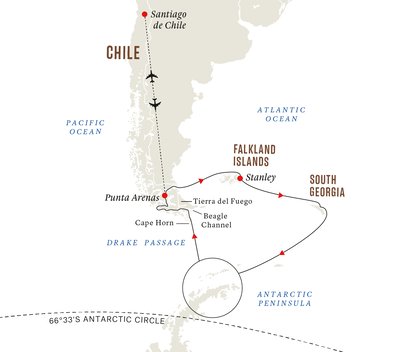
23 Day In-depth Antarctica, Falklands & South Georgia Expedition Onboard Ms Fram
This tour is categorised as 3 out of 5
Balanced exploration with walking tours: Our most popular style, this tour offers a good mix of planned activities and free time. Expect moderate daily walking tours, so pack comfortable shoes.
As a general requirement across all of our trips, you may be required to walk up and down stairs, get on and off transportation, handle your own luggage, and participate in all scheduled sightseeing that may be conducted on uneven ground and terrain. Any physical ailments you may have must be disclosed at the time of booking to determine your suitability and where required, supporting documentation may be requested to ensure that we are comfortable that you will enjoy your trip.
For the true explorer, expedition small-ship cruising is the best way to get off the beaten track.This experience is not just about the ship’s creature comforts but very much the destination, its nature and wildlife. Daily shore excursions by Zodiac inflatable boats allow you to step onshore and explore. A world-class, expert expedition team will help you discover each exciting destination. Onboard you’ll enjoy informative and educational lectures. These trips will be a mix of fully guided or self-guided depending on your chosen package. There’s a land touring component with shared sightseeing and transfers.
Inspiring Vacations has been globally recognised and awarded for its handling of COVID-19 during the pandemic. The safety and wellbeing of our guests is our highest concern during this time of uncertainty, and we are continuously monitoring the evolving COVID-19 situation.
We have adopted the advice of the WHO to ensure all customers can travel with the knowledge of how to travel safely and with confidence.
Australian owned and operated with 100% Australian Customer Service support
We are proudly 100% Australian owned and operated, with our head office located in Melbourne, Victoria. When you make your booking, you will receive dedicated and ongoing support from our team of travel professionals throughout your booking, up until you are due to depart.
✓ Travel with Hurtigruten
✓ Explore this wild and wonderful frozen continent
✓ See penguins, whales, and seals in their natural habitat
✓ Experience endless ranges of snow-coated mountains
✓ Discover the majesty of the iceberg sculpted by sun, wind, and waves
✓ Experience a beacon for abundant wildlife; whales, seals, seabirds, and penguins
✓ Go on landings ashore, on small boat cruises, kayaking, snowshoeing, camping, and more
✓ Hurtigruten’s ships combine hybrid technology with lowest CO2-footprint possible
✓ 1 overnight in Santiago de Chile before the expedition cruise, including breakfast
✓ Round-trip economy flights from selected cities in Australia or New Zealand to Santiago de Chile
✓ Round-trip flights in economy class between Santiago de Chile and Punta Arenas
✓ Enjoined with English-speaking Expedition Team activities onboard and ashore
✓ Complimentary Wi-Fi onboard
Travel with the experts for a carefully curated, value-packed discovery of the world's most iconic destinations. Our tours are bursting with must-see sights, rich experiences and quality inclusions, all at an unbeatable price. Bucket list dreams are ticked off on these all-encompassing journeys.
Your expedition starts with an overnight stay in Santiago, the energetic and cultural core of Chile. Filled with museums, beautiful architecture and top-notch restaurants, the city has all the high notes you would expect of a capital. There is a wealth of sites and attractions to see, and you’ll only be limited by time, not choice.
Ride the historic funicular up to Cerro San Cristóbal for commanding views of the city and the Andean glaciers beyond. This is the largest park in the city and the site of the national zoo and botanic gardens. Surrounding the park is the hip Bella Vista neighbourhood which is great to wander around for chilled-out cafés by day and Latin-inspired bars and clubs by night. A walk to the 18th century presidential palace and historical heart Plaza de Armas will ensure you have enough snaps of the main landmarks.If you’ve time, head toMercado Central fish market to sample classic Chilean seafood stew caldillo de congrio.
Should you feel you need more time to explore the capital, we recommend coming a few days early. Maybe you even want to go on our optional pre-programme to the amazing Atacama Desert or Chilean Patagonia?
You leave Santiago early in the morning, so make sure to set your alarm. From the airport, you fly to Punta Arenas, the capital of Chile’s southernmost region located on the Brunswick Peninsula, just north of the Strait of Magellan. What began as a penal colony boomed during the gold-rush and sheep-farming periods of the 1880s and early 1900s and is now one of only two low-tax ports in Chile.
MS Fram, Polar Outside is waiting here for you, ready to get you started on your expedition cruise to Antarctica. Aboard the ship, you’ll meet and greet the Expedition Team and crew members. They’ll conduct a health and safety meeting for all guests before we set sail. Head out on the observation deck to catch a last glimpse of Punta Arenas as we begin our course south. Then sip on drinks and turn your eyes towards Antarctica while you enjoy views from the Explorer Lounge & Bar.
Long after your epic voyage is over and you’re flicking through your pictures, you’ll realise that it was here, the Strait of Magellan, where your adventure truly began. It was named after Portuguese explorer Fernando de Magallanes who discovered it when he captained a Spanish expedition to circumnavigate the world in 1520. As you soak up the mesmerising views all around you, spare a thought for Fernando and his crew charting these waters in a rickety ship 500 years ago.
With our course set for the Falkland Islands, you’ll now be in the hands of the expert Expedition Team. You’ll find that they are not just inspirational teachers and attentive hosts, but bonafide adventurers who’ve got their share of stories to tell. Whether it’s about marine biology, Arctic survival, oceanography or photography, you’ll feed off their enthusiasm in each lecture. You can join them in the lecture hall and in the Science Center to learn about the Falklands interesting history and fascinating wildlife. If you are interested in art, you can attend art classes and even learn how to tie knots for when you go on landings.
Good times are also to be had in our restaurants which are located in the aft of the ship. You’ll note that wherever your table is placed, you’ll be able to gaze on the views outdoors. The strait also looks great while soaking in the outdoor hot tubs on deck 7.
The Falkland Islands are probably best known for their chequered past. Discovered by the British, settled by the French and the Spanish,they were then fought over by Argentina and Great Britain in the Falklands War. You will understand why these islands are so desirablewhen you see the natural beauty hidden in these islands across the three days we explore here.
The windswept green hills are home to large farms that have been family-owned for generations. And the beaches! The white sands and clear waters could easily be mistaken for the Caribbean.You will see penguin colonies alongsidegrazing sheep, while caracaras patrol overhead and geese forage at the water’s edge.
There are close to 800 islands here and the list of possible places to visit is pretty long. Rather than be forced into a fixed itinerary, we prefer to keep your exploration loose and spontaneous. This is an adventure after all!The Expedition Team and Captain will look at the sea and weather conditions at the time and then pick the safest sites for that day. So, whether it’s Saunders Island, West Point, Carcass Island, or another location that we visit, you can be sure it’ll be the best option for your expedition.
One place that we will likely be able to visit is Stanley, the capital of the archipelago on East Falkland. It’s a great little town to explore on foot and an excellent starting point for the optional excursions you can pick from. While in the town centre, you’ll likely want to visit its array of local shops and maybe even stop in at an Englishpub to share a pint with the friendly locals.
The Falkland Islands are probably best known for their chequered past. Discovered by the British, settled by the French and the Spanish,they were then fought over by Argentina and Great Britain in the Falklands War. You will understand why these islands are so desirablewhen you see the natural beauty hidden in these islands across the three days we explore here.
The windswept green hills are home to large farms that have been family-owned for generations. And the beaches! The white sands and clear waters could easily be mistaken for the Caribbean.You will see penguin colonies alongsidegrazing sheep, while caracaras patrol overhead and geese forage at the water’s edge.
There are close to 800 islands here and the list of possible places to visit is pretty long. Rather than be forced into a fixed itinerary, we prefer to keep your exploration loose and spontaneous. This is an adventure after all!The Expedition Team and Captain will look at the sea and weather conditions at the time and then pick the safest sites for that day. So, whether it’s Saunders Island, West Point, Carcass Island, or another location that we visit, you can be sure it’ll be the best option for your expedition.
One place that we will likely be able to visit is Stanley, the capital of the archipelago on East Falkland. It’s a great little town to explore on foot and an excellent starting point for the optional excursions you can pick from. While in the town centre, you’ll likely want to visit its array of local shops and maybe even stop in at an Englishpub to share a pint with the friendly locals.
The Falkland Islands are probably best known for their chequered past. Discovered by the British, settled by the French and the Spanish,they were then fought over by Argentina and Great Britain in the Falklands War. You will understand why these islands are so desirablewhen you see the natural beauty hidden in these islands across the three days we explore here.
The windswept green hills are home to large farms that have been family-owned for generations. And the beaches! The white sands and clear waters could easily be mistaken for the Caribbean.You will see penguin colonies alongsidegrazing sheep, while caracaras patrol overhead and geese forage at the water’s edge.
There are close to 800 islands here and the list of possible places to visit is pretty long. Rather than be forced into a fixed itinerary, we prefer to keep your exploration loose and spontaneous. This is an adventure after all!The Expedition Team and Captain will look at the sea and weather conditions at the time and then pick the safest sites for that day. So, whether it’s Saunders Island, West Point, Carcass Island, or another location that we visit, you can be sure it’ll be the best option for your expedition.
One place that we will likely be able to visit is Stanley, the capital of the archipelago on East Falkland. It’s a great little town to explore on foot and an excellent starting point for the optional excursions you can pick from. While in the town centre, you’ll likely want to visit its array of local shops and maybe even stop in at an Englishpub to share a pint with the friendly locals.
Sailing from the Falklands, we spend two days cruising towards beautiful South Georgia. Known as the Galápagos of the Poles, you can look forward to seeing an archipelago of impressive and diverse wildlife.
But that’s still a couple of days away, so meet up with your friends in the Expedition Team and listen as they give you a heads up on what you can expect. They will tell you everything they know about South Georgia, including information about the area’s wildlife, polar history, its geology, glaciology and legends of Norwegian whalers.
One of the fascinating stories in their canon is that of Sir Ernest Shackleton, the crew of the ill-fated ship Endurance, and their amazing feats of bravery.You’ll also learn how to make your visit as safe and as sustainable as possible and you can join Citizen Science programmes to help collect data for current scientific research.
Sailing from the Falklands, we spend two days cruising towards beautiful South Georgia. Known as the Galápagos of the Poles, you can look forward to seeing an archipelago of impressive and diverse wildlife.
But that’s still a couple of days away, so meet up with your friends in the Expedition Team and listen as they give you a heads up on what you can expect. They will tell you everything they know about South Georgia, including information about the area’s wildlife, polar history, its geology, glaciology and legends of Norwegian whalers.
One of the fascinating stories in their canon is that of Sir Ernest Shackleton, the crew of the ill-fated ship Endurance, and their amazing feats of bravery.You’ll also learn how to make your visit as safe and as sustainable as possible and you can join Citizen Science programmes to help collect data for current scientific research.
If you love wildlife, you’re going to love South Georgia. Nicknames like ‘Serengeti of the Southern Ocean’ and ‘Galápagos of the Poles’ promise a lot, but the islands more than live up to their reputation. Coming here, you’ll understand why South Georgia is a top spot for wildlife photographers from all over the world.
Uniquely positioned inside the Antarctic ecosystem yet outside the reach of sea ice, South Georgia is an ideal home for thousands of breeding penguins and seals. There are notable populations of king penguins who prefer the warmer weather here than their emperor cousins in Antarctica. Both South Georgia and the South Sandwich Islands have also been identified as Important Bird Areas, supporting many seabirds including albatross, penguins, petrels, shags, skuas and terns.
We spend five days in South Georgia, and plan to go ashore at several possible places to take you closer to the wilderness and wildlife. One such place is the settlement of Grytviken, home to a Norwegian seaman’s church built in 1913 and the final resting place of Antarctic explorer Sir Ernest Shackleton.
However, like the Falklands, our itinerary is not set in stone. We know all the interesting sites and penguin colonies to take you to, but we always adjust our plans according to the weather conditions. That’s what makes our expedition cruises so memorable.
If you love wildlife, you’re going to love South Georgia. Nicknames like ‘Serengeti of the Southern Ocean’ and ‘Galápagos of the Poles’ promise a lot, but the islands more than live up to their reputation. Coming here, you’ll understand why South Georgia is a top spot for wildlife photographers from all over the world.
Uniquely positioned inside the Antarctic ecosystem yet outside the reach of sea ice, South Georgia is an ideal home for thousands of breeding penguins and seals. There are notable populations of king penguins who prefer the warmer weather here than their emperor cousins in Antarctica. Both South Georgia and the South Sandwich Islands have also been identified as Important Bird Areas, supporting many seabirds including albatross, penguins, petrels, shags, skuas and terns.
We spend five days in South Georgia, and plan to go ashore at several possible places to take you closer to the wilderness and wildlife. One such place is the settlement of Grytviken, home to a Norwegian seaman’s church built in 1913 and the final resting place of Antarctic explorer Sir Ernest Shackleton.
However, like the Falklands, our itinerary is not set in stone. We know all the interesting sites and penguin colonies to take you to, but we always adjust our plans according to the weather conditions. That’s what makes our expedition cruises so memorable.
If you love wildlife, you’re going to love South Georgia. Nicknames like ‘Serengeti of the Southern Ocean’ and ‘Galápagos of the Poles’ promise a lot, but the islands more than live up to their reputation. Coming here, you’ll understand why South Georgia is a top spot for wildlife photographers from all over the world.
Uniquely positioned inside the Antarctic ecosystem yet outside the reach of sea ice, South Georgia is an ideal home for thousands of breeding penguins and seals. There are notable populations of king penguins who prefer the warmer weather here than their emperor cousins in Antarctica. Both South Georgia and the South Sandwich Islands have also been identified as Important Bird Areas, supporting many seabirds including albatross, penguins, petrels, shags, skuas and terns.
We spend five days in South Georgia, and plan to go ashore at several possible places to take you closer to the wilderness and wildlife. One such place is the settlement of Grytviken, home to a Norwegian seaman’s church built in 1913 and the final resting place of Antarctic explorer Sir Ernest Shackleton.
However, like the Falklands, our itinerary is not set in stone. We know all the interesting sites and penguin colonies to take you to, but we always adjust our plans according to the weather conditions. That’s what makes our expedition cruises so memorable.
If you love wildlife, you’re going to love South Georgia. Nicknames like ‘Serengeti of the Southern Ocean’ and ‘Galápagos of the Poles’ promise a lot, but the islands more than live up to their reputation. Coming here, you’ll understand why South Georgia is a top spot for wildlife photographers from all over the world.
Uniquely positioned inside the Antarctic ecosystem yet outside the reach of sea ice, South Georgia is an ideal home for thousands of breeding penguins and seals. There are notable populations of king penguins who prefer the warmer weather here than their emperor cousins in Antarctica. Both South Georgia and the South Sandwich Islands have also been identified as Important Bird Areas, supporting many seabirds including albatross, penguins, petrels, shags, skuas and terns.
We spend five days in South Georgia, and plan to go ashore at several possible places to take you closer to the wilderness and wildlife. One such place is the settlement of Grytviken, home to a Norwegian seaman’s church built in 1913 and the final resting place of Antarctic explorer Sir Ernest Shackleton.
However, like the Falklands, our itinerary is not set in stone. We know all the interesting sites and penguin colonies to take you to, but we always adjust our plans according to the weather conditions. That’s what makes our expedition cruises so memorable.
If you love wildlife, you’re going to love South Georgia. Nicknames like ‘Serengeti of the Southern Ocean’ and ‘Galápagos of the Poles’ promise a lot, but the islands more than live up to their reputation. Coming here, you’ll understand why South Georgia is a top spot for wildlife photographers from all over the world.
Uniquely positioned inside the Antarctic ecosystem yet outside the reach of sea ice, South Georgia is an ideal home for thousands of breeding penguins and seals. There are notable populations of king penguins who prefer the warmer weather here than their emperor cousins in Antarctica. Both South Georgia and the South Sandwich Islands have also been identified as Important Bird Areas, supporting many seabirds including albatross, penguins, petrels, shags, skuas and terns.
We spend five days in South Georgia, and plan to go ashore at several possible places to take you closer to the wilderness and wildlife. One such place is the settlement of Grytviken, home to a Norwegian seaman’s church built in 1913 and the final resting place of Antarctic explorer Sir Ernest Shackleton.
However, like the Falklands, our itinerary is not set in stone. We know all the interesting sites and penguin colonies to take you to, but we always adjust our plans according to the weather conditions. That’s what makes our expedition cruises so memorable.
With lengthy stays in both the Falklands and South Georgia, you have had time to really immerse yourself in the destinations and their wildlife. Our Expedition Team now focuses your attention on the main event of your expedition – Antarctica. You’ll take in comprehensive lectures and presentations covering polar explorer history, environment and, of course, the wildlife of the region.
Throughout our journey, the Expedition Team will also be taking water samples for you to study under the microscopes in the Science Center, allowing you to see wildlife at the cellular level.
As we are getting closer to Antarctica, the Expedition Team will talk about the very strict environmental guidelines and sustainability rules outlined by IAATO that we follow. This is a continent dedicated to peace, science and tourism. No human activity is permitted that might interfere with the natural balance that exists here. We want to leave nothing but footprints and take nothing but pictures. And even then, sometimes we’ll wipe away our footprints to prevent penguins from getting stuck in them!
As always, the amenities of the ship are there for you to enjoy. If you haven’t yet worked up a sweat in the gym or the sauna, now is your opportunity. Don’t forget to go out on deck from time to time on your way to Antarctica. Spotting that first huge iceberg is always a real highlight.
Forget everything you have ever experienced before. Antarctica is in a league of its own. No matter how high your expectations are, Antarctica never disappoints. Holding 90% of the world’s ice, it’s massive in every sense of the word. The only country in the world with more surface area is Russia. There is actually land to be found underneath all the ice, but in some places, you would have to dig your way through four kilometres of snow and ice to reach it.
You will probably see your first seals and penguins from the ship, and that in itself is a fantastic experience. But wait until you stand on the very same shore as a colony of thousands of penguins. Or if a seal showsup beside you as you enjoy an optional activity of kayaking among the icebergs. Caught up in the thrill of the moment, you might not even remember to reach for your camera to take a picture!
Just as the icescapes of Antarctica change through its seasons, so does its wildlife. In early spring there will be much more snow, making the landscapes even more pristine. This is when the penguins are meeting up. We rarely see whales at this time of year, in October and November. In December, however, whales become more frequent. That’s also when the first penguin chicks hatch, which is always a charming sight. February and March are the peak of whale-watching opportunities, as the large amount of krill in the waters attract the most whale species who come for a veritable feeding frenzy.
There will be less snow then, and you will be able to see the clumsy penguin chicks are running around. If you are interested in birds, however, there are 46 species of birds here, including various petrels, albatrosses and terns.
Our Expedition Team will take very good care of you while you enjoy everything that Antarctica has to offer over the next five days. You can join them in ice-cruising andlandings to really explore the icescapes of this frozen continent. If you are here early in the season when snow conditions are good, you may even get the chance to go snowshoeing. As before, there is no set list of sites we will definitely visit. We submit to the elements, allowing wind and sea ice to guide us in picking the best landing zones.
Forget everything you have ever experienced before. Antarctica is in a league of its own. No matter how high your expectations are, Antarctica never disappoints. Holding 90% of the world’s ice, it’s massive in every sense of the word. The only country in the world with more surface area is Russia. There is actually land to be found underneath all the ice, but in some places, you would have to dig your way through four kilometres of snow and ice to reach it.
You will probably see your first seals and penguins from the ship, and that in itself is a fantastic experience. But wait until you stand on the very same shore as a colony of thousands of penguins. Or if a seal showsup beside you as you enjoy an optional activity of kayaking among the icebergs. Caught up in the thrill of the moment, you might not even remember to reach for your camera to take a picture!
Just as the icescapes of Antarctica change through its seasons, so does its wildlife. In early spring there will be much more snow, making the landscapes even more pristine. This is when the penguins are meeting up. We rarely see whales at this time of year, in October and November. In December, however, whales become more frequent. That’s also when the first penguin chicks hatch, which is always a charming sight. February and March are the peak of whale-watching opportunities, as the large amount of krill in the waters attract the most whale species who come for a veritable feeding frenzy.
There will be less snow then, and you will be able to see the clumsy penguin chicks are running around. If you are interested in birds, however, there are 46 species of birds here, including various petrels, albatrosses and terns.
Our Expedition Team will take very good care of you while you enjoy everything that Antarctica has to offer over the next five days. You can join them in ice-cruising andlandings to really explore the icescapes of this frozen continent. If you are here early in the season when snow conditions are good, you may even get the chance to go snowshoeing. As before, there is no set list of sites we will definitely visit. We submit to the elements, allowing wind and sea ice to guide us in picking the best landing zones.
Forget everything you have ever experienced before. Antarctica is in a league of its own. No matter how high your expectations are, Antarctica never disappoints. Holding 90% of the world’s ice, it’s massive in every sense of the word. The only country in the world with more surface area is Russia. There is actually land to be found underneath all the ice, but in some places, you would have to dig your way through four kilometres of snow and ice to reach it.
You will probably see your first seals and penguins from the ship, and that in itself is a fantastic experience. But wait until you stand on the very same shore as a colony of thousands of penguins. Or if a seal showsup beside you as you enjoy an optional activity of kayaking among the icebergs. Caught up in the thrill of the moment, you might not even remember to reach for your camera to take a picture!
Just as the icescapes of Antarctica change through its seasons, so does its wildlife. In early spring there will be much more snow, making the landscapes even more pristine. This is when the penguins are meeting up. We rarely see whales at this time of year, in October and November. In December, however, whales become more frequent. That’s also when the first penguin chicks hatch, which is always a charming sight. February and March are the peak of whale-watching opportunities, as the large amount of krill in the waters attract the most whale species who come for a veritable feeding frenzy.
There will be less snow then, and you will be able to see the clumsy penguin chicks are running around. If you are interested in birds, however, there are 46 species of birds here, including various petrels, albatrosses and terns.
Our Expedition Team will take very good care of you while you enjoy everything that Antarctica has to offer over the next five days. You can join them in ice-cruising andlandings to really explore the icescapes of this frozen continent. If you are here early in the season when snow conditions are good, you may even get the chance to go snowshoeing. As before, there is no set list of sites we will definitely visit. We submit to the elements, allowing wind and sea ice to guide us in picking the best landing zones.
Forget everything you have ever experienced before. Antarctica is in a league of its own. No matter how high your expectations are, Antarctica never disappoints. Holding 90% of the world’s ice, it’s massive in every sense of the word. The only country in the world with more surface area is Russia. There is actually land to be found underneath all the ice, but in some places, you would have to dig your way through four kilometres of snow and ice to reach it.
You will probably see your first seals and penguins from the ship, and that in itself is a fantastic experience. But wait until you stand on the very same shore as a colony of thousands of penguins. Or if a seal showsup beside you as you enjoy an optional activity of kayaking among the icebergs. Caught up in the thrill of the moment, you might not even remember to reach for your camera to take a picture!
Just as the icescapes of Antarctica change through its seasons, so does its wildlife. In early spring there will be much more snow, making the landscapes even more pristine. This is when the penguins are meeting up. We rarely see whales at this time of year, in October and November. In December, however, whales become more frequent. That’s also when the first penguin chicks hatch, which is always a charming sight. February and March are the peak of whale-watching opportunities, as the large amount of krill in the waters attract the most whale species who come for a veritable feeding frenzy.
There will be less snow then, and you will be able to see the clumsy penguin chicks are running around. If you are interested in birds, however, there are 46 species of birds here, including various petrels, albatrosses and terns.
Our Expedition Team will take very good care of you while you enjoy everything that Antarctica has to offer over the next five days. You can join them in ice-cruising andlandings to really explore the icescapes of this frozen continent. If you are here early in the season when snow conditions are good, you may even get the chance to go snowshoeing. As before, there is no set list of sites we will definitely visit. We submit to the elements, allowing wind and sea ice to guide us in picking the best landing zones.
Forget everything you have ever experienced before. Antarctica is in a league of its own. No matter how high your expectations are, Antarctica never disappoints. Holding 90% of the world’s ice, it’s massive in every sense of the word. The only country in the world with more surface area is Russia. There is actually land to be found underneath all the ice, but in some places, you would have to dig your way through four kilometres of snow and ice to reach it.
You will probably see your first seals and penguins from the ship, and that in itself is a fantastic experience. But wait until you stand on the very same shore as a colony of thousands of penguins. Or if a seal showsup beside you as you enjoy an optional activity of kayaking among the icebergs. Caught up in the thrill of the moment, you might not even remember to reach for your camera to take a picture!
Just as the icescapes of Antarctica change through its seasons, so does its wildlife. In early spring there will be much more snow, making the landscapes even more pristine. This is when the penguins are meeting up. We rarely see whales at this time of year, in October and November. In December, however, whales become more frequent. That’s also when the first penguin chicks hatch, which is always a charming sight. February and March are the peak of whale-watching opportunities, as the large amount of krill in the waters attract the most whale species who come for a veritable feeding frenzy.
There will be less snow then, and you will be able to see the clumsy penguin chicks are running around. If you are interested in birds, however, there are 46 species of birds here, including various petrels, albatrosses and terns.
Our Expedition Team will take very good care of you while you enjoy everything that Antarctica has to offer over the next five days. You can join them in ice-cruising andlandings to really explore the icescapes of this frozen continent. If you are here early in the season when snow conditions are good, you may even get the chance to go snowshoeing. As before, there is no set list of sites we will definitely visit. We submit to the elements, allowing wind and sea ice to guide us in picking the best landing zones.
Five unforgettable days in Antarctica are over, and MS Fram, Polar Outside has turned around to take you back north over the Drake Passage. Known for its potentially high winds and strong currents, the passage can also be silent and still, inspiring the nicknames ‘The Drake Shake’ and ‘The Drake Lake’ respectively. But don’t worry, even if we experience rough seas, you will be perfectly safe on our purpose-built expedition ship.
During our crossing, the Expedition Team will recap our experiences of Antarctica, making it possible to keep your head in Antarctica for a little while longer. As your cruise is coming close to its end, this is also the perfect time to go through the pictures you have taken on your cruise. And for all the things you have loved to do so far on the ship, there is still time to do all of them a couple of times more.
When we have put the Drake Passage behind us, we enter the scenic Beagle Channel, surrounded by mountains plunging straight into the icy water. Watch for rare endemic Peale’s dolphin and other wildlife as we sail in this wild and remote area that seems almost undisturbed by humans.
Five unforgettable days in Antarctica are over, and MS Fram, Polar Outside has turned around to take you back north over the Drake Passage. Known for its potentially high winds and strong currents, the passage can also be silent and still, inspiring the nicknames ‘The Drake Shake’ and ‘The Drake Lake’ respectively. But don’t worry, even if we experience rough seas, you will be perfectly safe on our purpose-built expedition ship.
During our crossing, the Expedition Team will recap our experiences of Antarctica, making it possible to keep your head in Antarctica for a little while longer. As your cruise is coming close to its end, this is also the perfect time to go through the pictures you have taken on your cruise. And for all the things you have loved to do so far on the ship, there is still time to do all of them a couple of times more.
When we have put the Drake Passage behind us, we enter the scenic Beagle Channel, surrounded by mountains plunging straight into the icy water. Watch for rare endemic Peale’s dolphin and other wildlife as we sail in this wild and remote area that seems almost undisturbed by humans.
Five unforgettable days in Antarctica are over, and MS Fram, Polar Outside has turned around to take you back north over the Drake Passage. Known for its potentially high winds and strong currents, the passage can also be silent and still, inspiring the nicknames ‘The Drake Shake’ and ‘The Drake Lake’ respectively. But don’t worry, even if we experience rough seas, you will be perfectly safe on our purpose-built expedition ship.
During our crossing, the Expedition Team will recap our experiences of Antarctica, making it possible to keep your head in Antarctica for a little while longer. As your cruise is coming close to its end, this is also the perfect time to go through the pictures you have taken on your cruise. And for all the things you have loved to do so far on the ship, there is still time to do all of them a couple of times more.
When we have put the Drake Passage behind us, we enter the scenic Beagle Channel, surrounded by mountains plunging straight into the icy water. Watch for rare endemic Peale’s dolphin and other wildlife as we sail in this wild and remote area that seems almost undisturbed by humans.
We arrive in Punta Arenas in the morning, back to civilisation again. You’ll transfer to the airport for a flight back to Santiago where you’ll have a second chance to explore the capital of Chile. Or maybe you would rather extend your vacation with a Post-Programme adventure to Easter Island, famous for its mysterious statues of giant heads? The choice is yours.Before that though, you’ll first make your fond farewells to one another, the crew and the Expedition Team.
How do you end an experience of 23 days at sea surrounded by some of the most remote, awe-inspiring scenery known to humankind? The answer is: you don’t. The experience will continue on with the memories and knowledge you now carry with you. It lives in the photos and stories you’ll bring back to your friends and family. We hope your experience of sustainable expedition cruising has been an inspiring one, renewing your awe for nature and reigniting a passion to protect it.
Cabin Bedding and Upgrades
Bedding on board the cruise is restricted to the following configurations. If you wish to upgrade your cabin, the following amounts are payable in addition to the package price prior to travel:
Polar Outside (N2): INCLUDED
Our Polar Outside cabins are mostly situated on the middle or lower decks and have a bathroom with a shower. These cabins also have a queen bed or separate beds. Each Polar Outside cabin has its own unique specifications.
Arctic Superior (U2)
Relaxation and comfort are hallmarks of the Arctic Superior cabins. Situated on both the upper and middle decks, the cabins all have a bathroom with a shower. Most have a queen bed, while some have separate beds. Each Arctic Superior cabin has its own unique specifications. Upgrades from AU$1,798 per person, twin share or AU$4,494 per person, single (subject to availability).
Expedition Suite (Q2)
Our Expedition Suites are the most luxurious cabins on the ship. Situated on the upper decks of the ship, these cabins feature seating areas with a TV, a bathroom with a shower, and a queen bed. Each Expedition Suite has its own unique specifications. Upgrades from AU$7,493 per person, twin share or AU$27,071 per person, single (subject to availability).
Cabin Upgrades and prices are subject to availability upon booking. Please note your upgrade option as a special request when booking and our team will be in touch with a confirmed quote. If we are unable to confirm your request, we will quote alternative options.
Please request your cabin upgrade in the 'special requests' field. Availability and price will then be confirmed and added to your invoice upon acceptance.
MS Fram, Polar Outside Carrying on the legacy of the original Fram, one of the most famous exploration vessels of all time, MS Fram, Polar Outside has been purpose-built to offer guests an authentic, intimate, and pure expedition experience in polar regions.
Fram means ‘forward’ – lifting expectations of the voyage ahead in true explorer spirit. MS Fram, Polar Outside is equipped with advanced technology which makes it especially well-suited for expeditions in Polar regions. The ship, refurbished in 2020, offers a modern Scandinavian interior design. As one of our smaller expedition vessels, it offers a comfortable and intimate sailing experience.
to know more about your ship, click HERE.
Onboard Features
Hotel
Flights
Transfers
Expedition Cruise
Onboard Activities
Landing Activities
Notes
Deposit & Payments
Booking Process
Booking On Request
COVID-19
Due to COVID there maybe disruptions to standard operating schedules of particular components of this itinerary. Should a component be effected a substitute will be confirmed prior to departure.
Fitness Requirements
While the tour itinerary should give you some guidance and overview to the expected requirements, to determine if this tour is right for you we categorise each of our tours in terms of their intensity.
These guidelines are to ensure that each tour group is conducted as expected and to ensure the overall satisfaction of all Inspiring Vacations customers. As a general rule, porterage is not included, therefore at all times you are expected to handle your own luggage where help may not be available.
Accommodation
The accommodation listed is subject to change. Any changes will be of an equal or higher standard. Bedding configurations (double or twin) are requests only and subject to availability. All efforts will be made to meet your preferences, however any changes are beyond our control.
Single Supplement
Please follow the 'book now' prompts and select 1 passenger to view the single supplement cost.
Triple Share
Not Available
Travel Insurance
Travel insurance is required to protect yourself against the unexpected.
Tour Documentation
Final documentation including, e-tickets and cruise details, will be provided approximately 30 days prior to travel.
Children
Children must share a room with parents at all times and are charged the same price as adults.
For all international voyages, it is the traveller's responsibility to ensure that they have a valid passport and they meet the visa requirement. The passport must be valid for a minimum of six months from the intended date of return.

 Australia
 New Zealand
 Canada